Taiping Bridge, Arch bridge in Keqiao District, Shaoxing, China
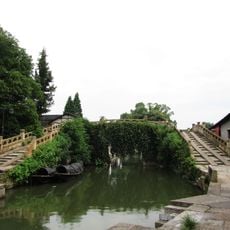
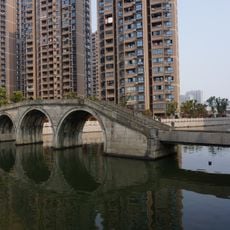
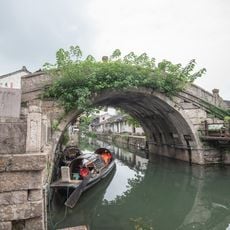
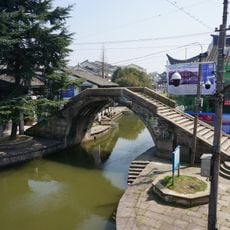
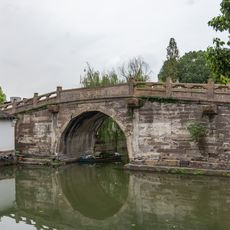
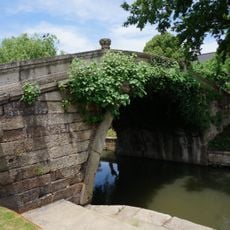
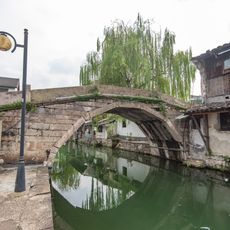
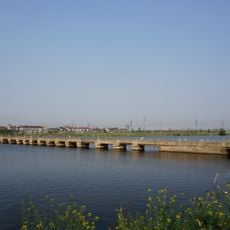
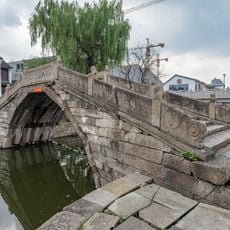
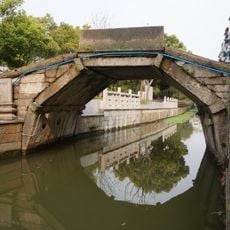
Taiping Bridge is a 40-metre stone bridge beside the Eastern Zhejiang Canal in Ruansi Village, Keyan Subdistrict, Keqiao District. It combines a single arch with a net span of 8.4 metres and eight beam spans of about 4.8 metres each, and is 3.5 metres wide. Four squatting lions sit on the arch's top posts, and the parapets carry lotus and floral motifs.
Taiping Bridge was first built in 1620, during the Wanli era of the Ming dynasty, and rebuilt in 1858 under the Xianfeng Emperor of the Qing dynasty. It was listed among the seventh batch of Major National Historical and Cultural Sites in Zhejiang on 6 May 2013.
The name Taiping, meaning "great peace", is a common auspicious name for old bridges in the Shaoxing area. At the northern end of the bridge once stood the Tianyi Temple, dedicated to Ni Zongxian, a celebrated early Qing dynasty physician from Shaoxing; the site later became Taiping Bridge Park.
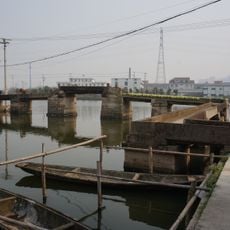
The bridge spans the Eastern Zhejiang Canal beside Ruansi Village in Keyan Subdistrict. Its 40 m length combines a single 8.4 m arch with eight beam spans of about 4.8 m each, and the beam section steps down toward the north. The arch's south end has platforms with two descending ramps, east and west, where worn repair inscriptions stand.
The bridge is a combined structure: a single 8.4-metre stone arch at the south end joined to an eight-span beam bridge whose spans step down northward, each about 4.8 metres. Four stone lions sit on the arch's top posts, and the parapets carry lotus and floral motifs.
The community of curious travelers
AroundUs brings together thousands of curated places, local tips, and hidden gems, enriched daily by 94,507 contributors worldwide.