Jiedu Bridge, Cultural heritage bridge in Shaoxing, China.
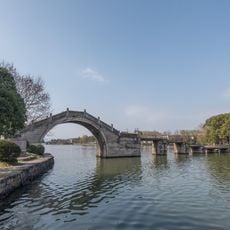
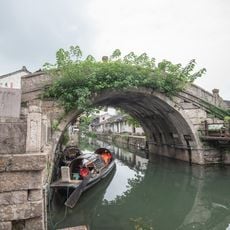
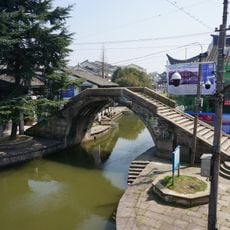
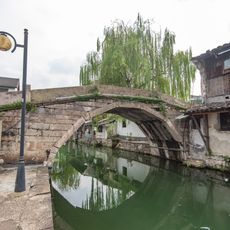
Jiedu Bridge is a stone arch structure that crosses a waterway in Shaoxing and displays traditional Chinese architectural features. The structure daily carries pedestrians and vehicles between different parts of the city.
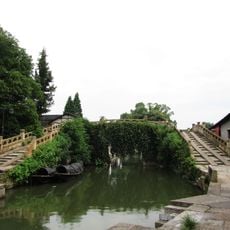
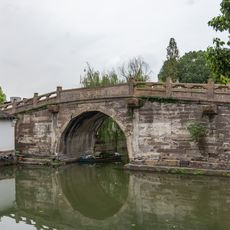
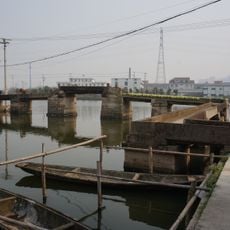
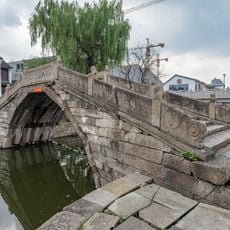
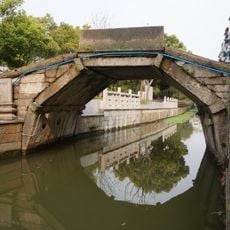
Jiedu Bridge was built in the Qing dynasty (1644–1911) as a combined arch-and-beam crossing of the Jilong River. Its three semicircular stone arches, each spanning 7.30 m, are flanked by a two-span east beam bridge and a west beam bridge now reduced to one span. On 6 May 2013 China's State Council listed it in the seventh batch of Major National Historical and Cultural Sites.
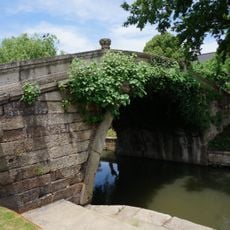
The bridge's name, Jiedu ("receiving crossing"), refers to its role carrying the old route across the Jilong River, whose name means "Chicken Coop River". Twelve stone lion finials once crowned the balustrade posts; most are now damaged, and the worn lions are the detail to look for. The bridge stands inside Zhongze Xinyuan residential compound, formerly Zhongze village.
The structure is publicly accessible and offers a direct route for pedestrians and vehicles across the waterway. It is part of the city's daily transport network and can be visited at any time.
The bridge is a composite arch-and-beam structure: a three-arch stone bridge flanked by beam spans, a single-arch west span (originally two) and a two-arch east span. Its three arches each span 7.30 metres, rising 3.9, 4.2 and 3.9 metres, and the east beam rests on cantilevered stone slabs projecting from the pier.
The community of curious travelers
AroundUs brings together thousands of curated places, local tips, and hidden gems, enriched daily by 94,019 contributors worldwide.