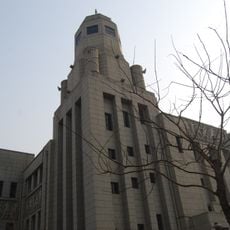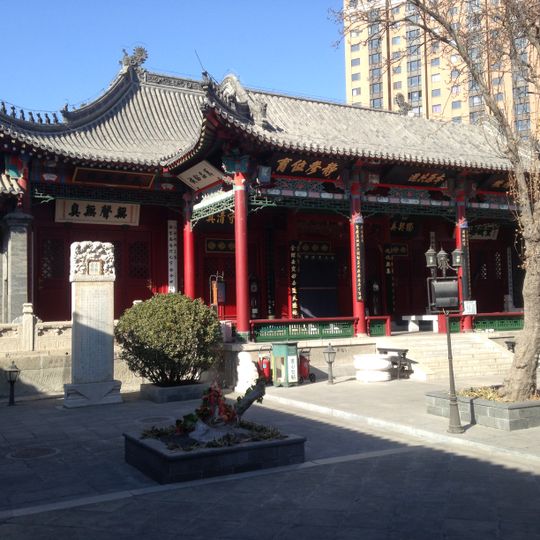
Tianjin Great Mosque, Historical mosque in Hongqiao District, China.
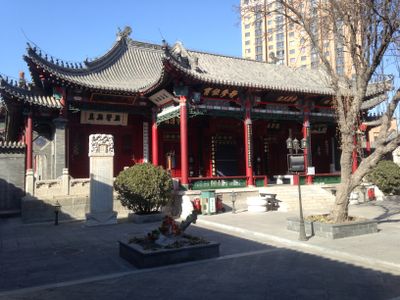
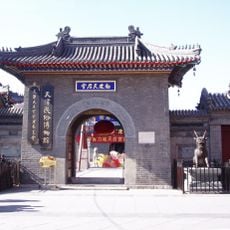
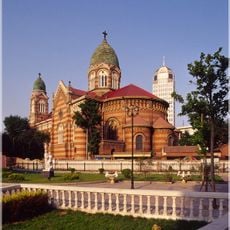
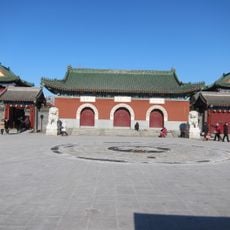
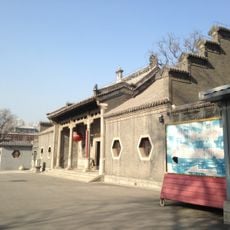
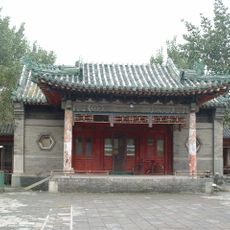
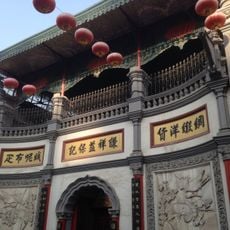
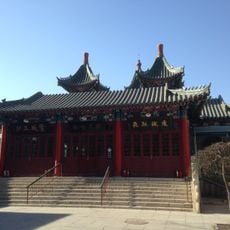
The Tianjin Great Mosque is a mosque in Hongqiao District featuring four main structures: the Prayer Hall, Preaching Hall, Screen Wall, and Archway. The entire complex is organized around a central courtyard and serves as a functional Islamic worship space with defined areas for different religious activities.
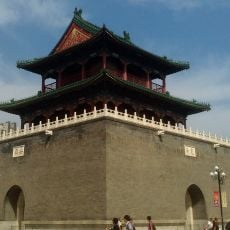
Founded in 1664, the first year of the Shunzhi reign, the mosque was enlarged in 1679 when the prayer hall grew to more than 30 bays. A second expansion began in 1801, funded by the local benefactor Shi Yiguang and completed in 1802. Later Qing additions included a stone platform and bathhouse in 1852, two pavilions and gate towers in 1865, and a screen wall in 1905.
The prayer hall's beams and columns carry 31 Chinese-language plaques and 8 couplets, alongside 18 Arabic plaques and four Arabic couplets. The inscriptions were donated by Qing princes such as Chun, Li and Su, and by Hui officials and scholars. A Qing-dynasty white marble plaque above the screen wall reads "Hua Zhao Wu Ji".
The Prayer Hall can accommodate over 1,000 worshippers and allows visitors to observe the architectural details from the courtyard areas. You can explore the outer spaces to understand the layout and see how the different buildings relate to each other.
During the Cultural Revolution most of the mosque's library of over 10,000 scriptures was burned; eight imams, including Zhang Shusen, hid more than 130 volumes, mostly manuscripts. Among the survivors are two miniature Qurans: one 3.5 cm long, 2.2 cm wide and 1.1 cm thick, about half a matchbox, and another 2.2 by 1.8 by 1 cm, roughly a third of one.
The community of curious travelers
AroundUs brings together thousands of curated places, local tips, and hidden gems, enriched daily by 94,431 contributors worldwide.