Memorial Hall of the Boxer Uprising, Museum of Chinese resistance in Hongqiao District, China
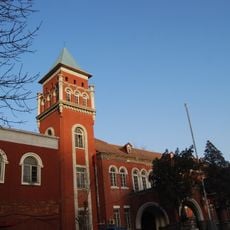
The Memorial Hall of the Boxer Uprising occupies the Lüzu Hall, a Taoist temple complex of grey brick and tile with a vermilion gate at 18 Hejia Lane, Hongqiao District. Its halls, side rooms and Wuxian Hall cover 1,300 square metres, and the museum displays 238 objects from a collection of over 2,000, including a reconstructed Boxer altar and a meeting hall with statues of leaders Cao Futian, Zhang Decheng, Lin Hei'er and Liu Chengxiang.
The site began as a village ancestral hall in 1433, during the Ming Xuande reign. In 1719 it was rebuilt as a Taoist temple to Lü Dongbin, and further repairs in 1795, 1839 and 1920 gave it its present layout. In 1900 Boxer leader Cao Futian made it the movement's general altar in Tianjin; it was restored in 1985 and opened as a museum on 1 January 1986.
The museum displays how ordinary people joined the movement to oppose foreign control and intervention in their country. Visitors see personal belongings and written records that reveal the beliefs and motivations of those who participated.
The hall sits at No. 18 Hejia Lane off Ruyi'an Street in Hongqiao District, in two courtyard houses south of the lane. The grounds rise from the low entrance through the halls to the rear courtyard, so expect steps and uneven thresholds. Exhibitions occupy 317 square metres of a 636-square-metre building.
Inside the original temple structure stood an altar where movement leaders performed rituals to invoke protection. Certain ritual objects and protective charms from this practice are preserved and displayed in the museum today.
The community of curious travelers
AroundUs brings together thousands of curated places, local tips, and hidden gems, enriched daily by 93,849 contributors worldwide.