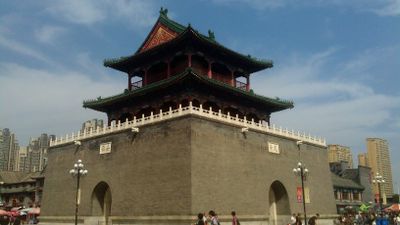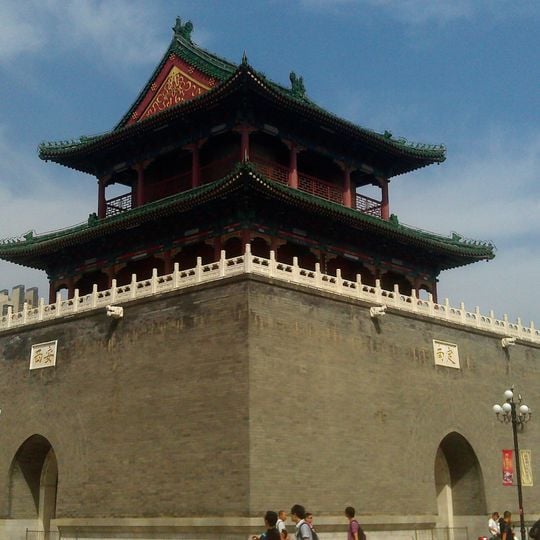
Tianjin Drum Tower, Drum tower in Nankai District, Tianjin, China.
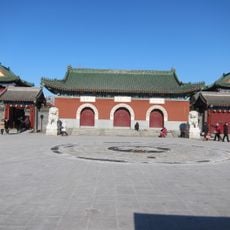
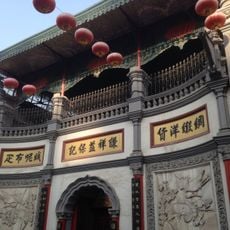
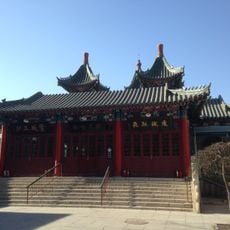
Tianjin Drum Tower is a 27-metre-high reconstruction completed in 2001, with a steel-concrete core faced as a brick base and a timber upper storey in Ming-Qing style. Four arched gateways pierce the base, inscribed above with Zhen Dong, An Xi, Ding Nan and Gong Bei. The upper storey carries grey tiles, green glazed edging, white marble balustrades and a double-eaved hip-and-gable roof.
Tianjin Drum Tower was built in 1493, during the Hongzhi reign, by Liu Fu, deputy military defense commissioner of Shandong, at the exact center of the old walled city. It was demolished on 7 November 1952, then rebuilt between 25 November 2000 and 28 September 2001 as part of the old city's redevelopment.
The tower's name comes from the great iron bell it once held, struck 108 times at dawn and dusk. The Qing poet Mei Xiaoshu wrote a couplet for the tower: "Climb high and look out at the sails of the seventy-two reaches; who can wake the bustle? Listen to the 108 strokes of the morning and evening bell." The calligrapher Hua Shikui inscribed the four gate names — Zhendong, Anxi, Dingnan, Gongbei — on the rebuilt tower in 1921.
The site is easily accessible by public transit, including metro line 2 to Gulou station and several bus routes serving the area. Wear comfortable shoes since exploring the multiple levels and surrounding streets involves considerable walking.
The original tower's iron bell, cast in Tang-Song style, was struck 108 times each morning and evening. The Qing poet Mei Xiaoshu wrote a couplet about it: watching the sails of the seventy-two gu on the river, and hearing the 108 bell strokes at dawn and dusk. The 2001 reconstruction is 27 metres tall, with a steel-concrete frame and a Ming-Qing style timber upper storey.
The community of curious travelers
AroundUs brings together thousands of curated places, local tips, and hidden gems, enriched daily by 94,378 contributors worldwide.