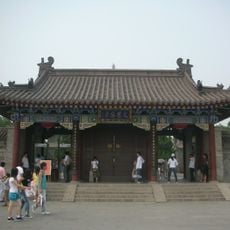
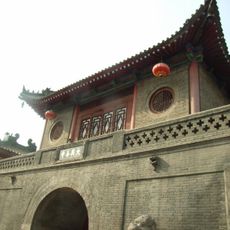
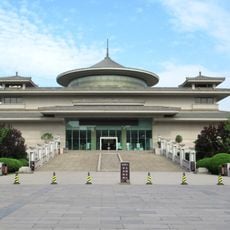
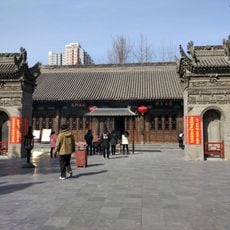
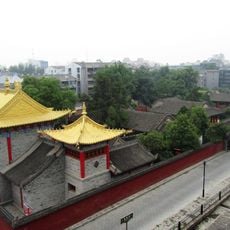
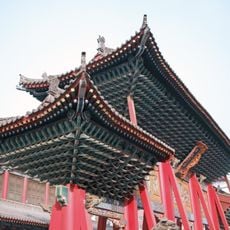
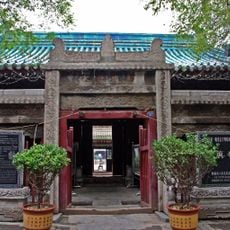
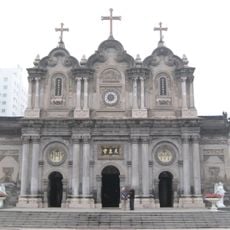
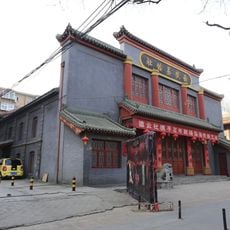
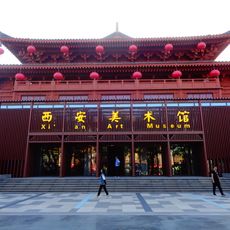
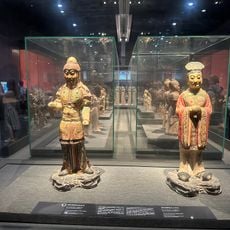
Zhuquemen, City gate in Beilin District, China.
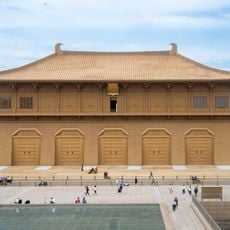
Zhuquemen is a gate opened in 1986 in the southern wall of Xi'an, between Wumu Gate and Yongning Gate. It has four arched openings built when the wall gap was repaired. Inside the gate lies Dabaoji Alley; outside is Zhuque Street. The gate takes its name from the Tang-era Zhuque Gate, whose site was excavated just east of it in 1985.
The original Zhuquemen was the main south gate of the Sui and Tang imperial city, opening onto the central Zhuque Street. It was walled up when Han Jian rebuilt the city in the late Tang. The present gate, opened in 1986, stands west of that Tang site, whose remains were excavated in 1985 inside the Ming wall.
The name Zhuque comes from Chinese mythology and represents the Vermilion Bird, a symbol of the fire element among the four celestial creatures. Visitors can observe this symbolic meaning reflected in the gate's decorative details and its spatial orientation.
Zhuquemen sits on the southern city wall between Wumumen (Small South Gate) and Yongningmen (South Gate). Inside the gate is Dabaoji Alley; outside, Zhuque Street runs south. The four arched openings were built in 1986, so the passage is short and direct. The Tang-era gate site was excavated just east of today's gate in 1985.
The gate stands west of the site where, in 1985, workers repairing the Ming wall uncovered the remains of the Tang-dynasty Zhuque Gate wrapped inside it. The present gate, cut through the wall in 1986, is named for that older gate, which lay just to its east.
The community of curious travelers
AroundUs brings together thousands of curated places, local tips, and hidden gems, enriched daily by 93,092 contributors worldwide.