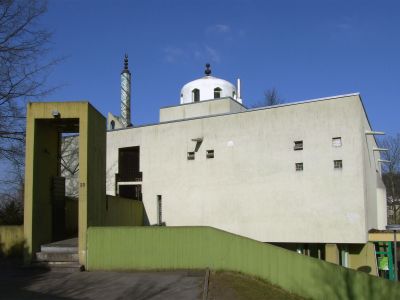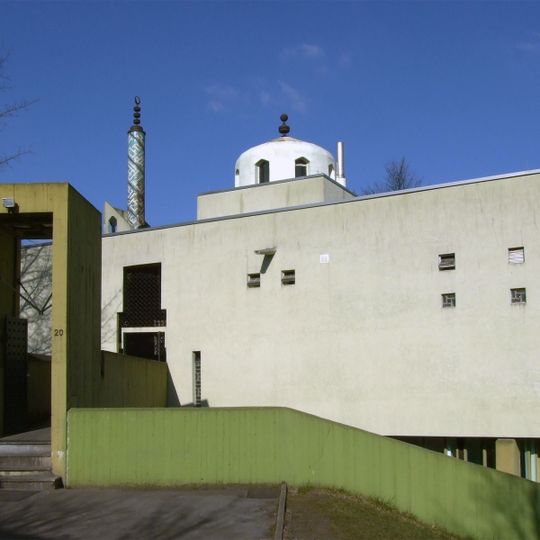
Bilal-Moschee, Mosque near RWTH Aachen University, Germany
Bilal Mosque is a square, three-storey building with a dome and a minaret, combining classical mosque architecture, classical modernism and contemporary church design. Its original form, with a courtyard and adjoining prayer hall, followed the type of the Arab hypostyle mosque. The exterior and interior were originally exposed concrete, with the stair tower's dome and the light domes above the prayer hall clad in zinc sheet.
Construction began in 1964 and the building was completed in 1971, at a time when Muslim communities were growing across German cities. It is considered one of the oldest mosques built in Germany after World War II.
The mosque is named after Bilal al-Habashi, the first muezzin in Islam. Its community, one of Germany's oldest Islamic congregations, runs the Islamic Center Aachen, which joins the 'Religions for Peace' discussion circle and a Christian-Islamic women's group. The center also distances itself from accusations of ties to the Syrian Muslim Brotherhood.
The mosque sits close to RWTH Aachen University and can be reached on foot from the city center without difficulty. Visitors are expected to dress modestly, and the building is busiest during prayer times.
In 2012, the building was listed as an architectural heritage monument, making it one of the very few mosques in Germany to receive that kind of official protection. The listing was based on its value as an example of modern religious architecture from the postwar era.
The community of curious travelers
AroundUs brings together thousands of curated places, local tips, and hidden gems, enriched daily by 94,387 contributors worldwide.