White Monastery, Coptic monastery in Sohag Governorate, Egypt
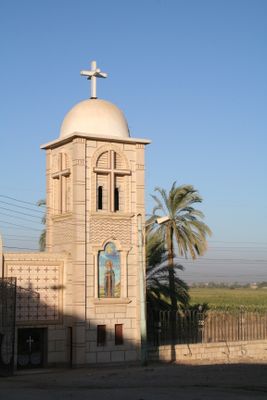
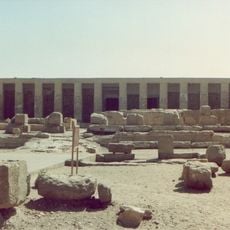
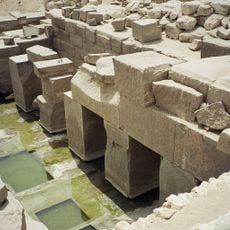
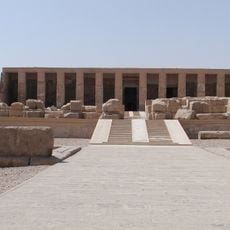
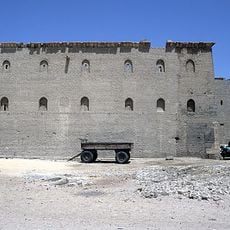
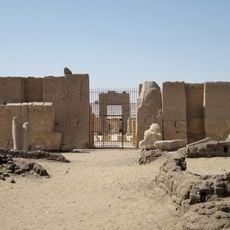
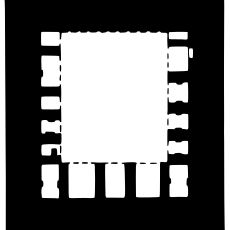
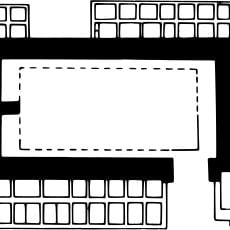
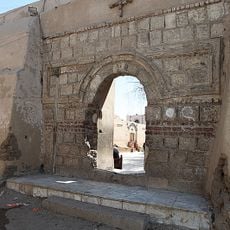
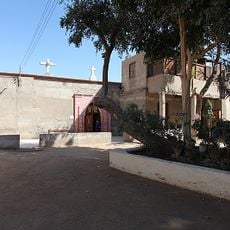
The White Monastery is a Coptic Orthodox monastery near Tahta and Sohag whose only surviving original structure is its 5th-century basilica-style church complex. Its outer walls of white limestone, laid in mortar without bonding and leaning inward six degrees, resemble an Egyptian temple. The church has six entrances and an open courtyard 172 feet by 76 feet, with a nave flanked by two aisles separated by long rows of columns. A medieval red brick wall divides the court from the current church, whose central, northern and southern apses are dedicated to Shenoute, the Virgin Mary and Saint George.
Saint Pigol, Shenoute's maternal uncle, founded the monastery in 442. Under Shenoute, who died in 466, the community grew from 30 monks to 2,200 monks and 1,800 nuns, and the monastery expanded to 12,800 acres. After the Arab conquest of 641, heavy taxes brought decline; in 1798 the Mamluks sacked and burned it, and parts were rebuilt from 1802 under Muhammad Ali.
The monastery is named for Saint Shenoute, who succeeded his uncle Pigol as abbot and died in 466. In the central apse, paintings dated between 1076 and 1124 carry inscriptions left by Armenian monks, among them the artist Theodore of Kaysun. The sanctuary is divided into three apses: the central one dedicated to Shenoute, the southern to the Virgin Mary and the northern to Saint George.
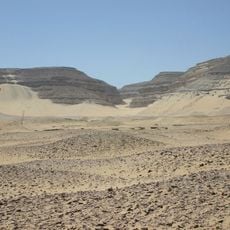
A visit works best with a planned route or guided tour, since the monastery sits in remote desert and local guidance helps with orientation. Bring water and sun protection, as the area is very open and hot.
The monastery once held one of the largest Coptic libraries known, with over 1,000 codices, of which only about a tenth survive. Its outer walls of white limestone, laid in mortar without bonding and leaning inward six degrees, gave the complex its name.
The community of curious travelers
AroundUs brings together thousands of curated places, local tips, and hidden gems, enriched daily by 93,240 contributors worldwide.