Giant Metrewave Radio Telescope, Radio interferometer in Narayangaon, Maharashtra, India.
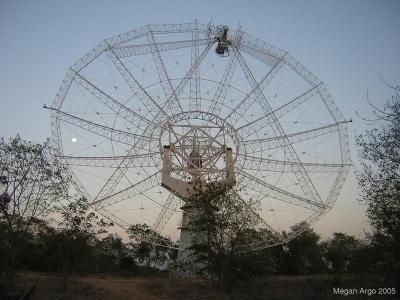
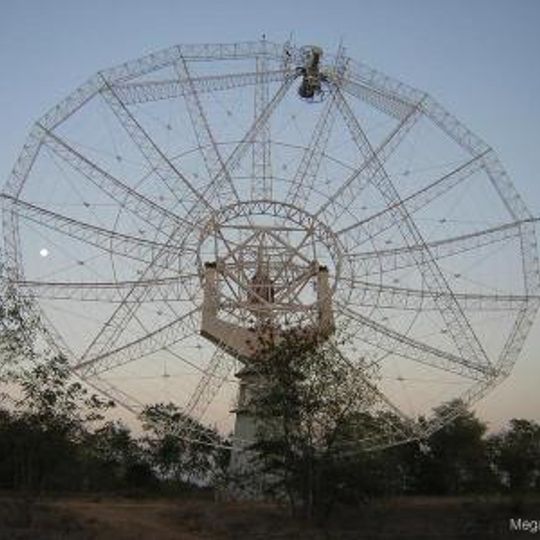
The Giant Metrewave Radio Telescope near Khodad, about 80 km north of Pune, is an array of 30 fully steerable parabolic dishes, each 45 metres across. The dishes form an interferometric array with baselines up to 25 kilometres. Each dish is a lattice of thin light-coloured metal beams, a wide circular net of radial and concentric members tilted upward, with a denser triangular frame at the centre and a small receiver unit near the top rim.
Conceived by Govind Swarup and built between 1984 and 1996 at Khodad, about 80 km north of Pune, the array was designed to detect highly redshifted 21-cm radiation from primordial neutral hydrogen and so trace the epoch of galaxy formation. It is operated by the National Centre for Radio Astrophysics, part of the Tata Institute of Fundamental Research, Mumbai. New receivers were later fitted, and the array became known as the upgraded GMRT (uGMRT).
Students and researchers visit the facility to watch scientists at work and learn how radio astronomy operates in practice. The site serves as a window into how India contributes to global space exploration and discovery.
The telescope receives radio signals across frequencies from 100 MHz to 1,500 MHz, allowing it to observe many types of cosmic objects. Visitors should know that the site is located in a remote area and it is worth checking access and timing details before planning a visit.
The telescope has observed radio galaxies at extreme distances whose signals traveled for billions of years to reach Earth. These distant observations help scientists understand what the early universe looked like and how galaxies developed over cosmic time.
The community of curious travelers
AroundUs brings together thousands of curated places, local tips, and hidden gems, enriched daily by 94,649 contributors worldwide.