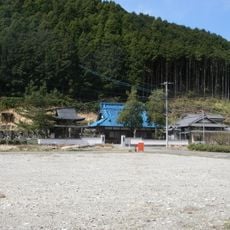
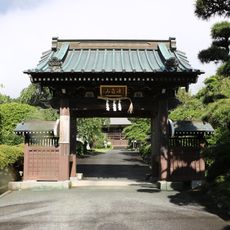
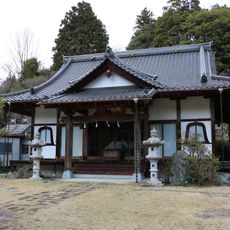
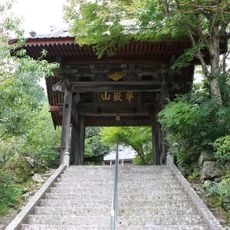
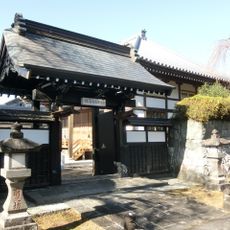
本遠寺, Buddhist temple in Minobu, Japan
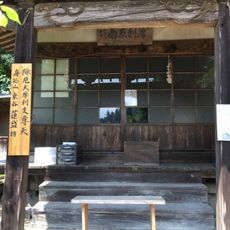
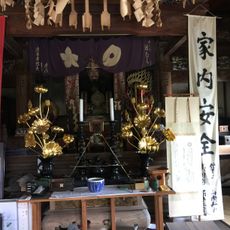
Hongenji is a Nichiren Buddhist temple in Minobu, Yamanashi Prefecture, founded in 1609 by the monk Nitchi En after he withdrew from Kuonji. Its main hall and bell tower, both built in 1650, are designated Important Cultural Properties; the main hall has an irimoya roof of cypress bark, and the bell tower is a two-story open structure. A fire in 1867 destroyed all buildings except these two.
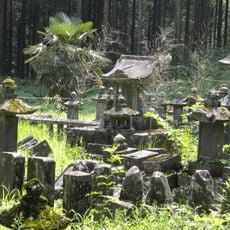
Founded in 1609 by Nisshin (Jien), the 22nd abbot of Kuonji, after he withdrew to Ono following the Keichō controversy and was pardoned through the intervention of Oman-no-kata, Tokugawa Ieyasu's concubine. She had her sons Yorinobu of Kishu and Yorifusa of Mito fund the large temple complex. In 1653 she was buried here beside her teacher, and in 1867 a fire destroyed all but the main hall and bell tower.
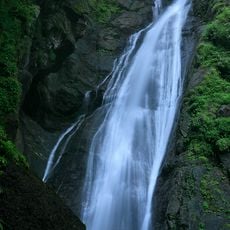
The temple is also called "Oman-sama's temple" after Yōjuin, the concubine of Tokugawa Ieyasu, whose grave lies beside that of her teacher Nitchin. The temple's name plaque was brushed in 1626 by Hon'ami Kōetsu for his parents' memorial. Yōjuin, credited as the first woman to climb Mount Shichimen in 1640, is honoured by a bronze statue near the Hakuun Shiraito falls.
The temple sits on a mountainside and requires appropriate footwear and some stamina for the climb. Coming early in the day is advisable so you can explore the grounds peacefully and avoid afternoon crowds.
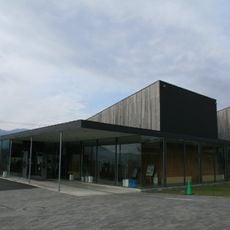
The temple's name plaque (hengaku) was brushed in 1626 by Hon'ami Kōetsu, the artist and Nichiren follower, for the repose of his parents. The temple also keeps a 97.8 cm wooden Shaka Nyorai statue, made in 1266 by Hōkyō Kakkei, son of Hōkyō Enkaku, now in the treasure hall.
The community of curious travelers
AroundUs brings together thousands of curated places, local tips, and hidden gems, enriched daily by 93,666 contributors worldwide.