Kanagawa Battery, Coastal defense fort in Kanagawa-ku, Japan.
Kanagawa Battery is a star-shaped coastal fortification in Kanagawa-ku, Yokohama, built on reclaimed land projecting into Tokyo Bay. It has a boat basin, a feature not found in other daiba, and covers about 26,000 square metres. Its star plan is one of only three such forts in Japan, alongside the one at Goryōkaku in Hakodate. The site is now occupied by JR Freight's Higashi-Takashima Station and surrounding redevelopment.
The Tokugawa shogunate ordered the Iyo-Matsuyama domain to guard the Kanagawa post town in 1857, and construction of the battery ran from July 1859 to June 1860 (old calendar). Katsu Kaishū designed it and Hirano Yajūrō directed the work. The domain's guard duty ended in 1866; the new Meiji government took over the site in 1868, and the battery was abolished in 1899.
The fort represents a meeting point where Japan adapted Western military technology while maintaining elements of traditional defense thinking. Walking through the remains, you can observe how both approaches shaped the structure's design.
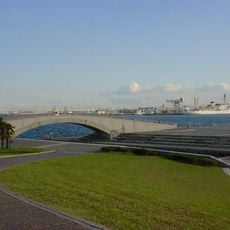
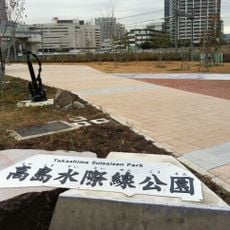
The site no longer exists as a visitable fort: its grounds are used by JR Freight's Higashi-Takashima Station and surrounding reclamation. Remains can be seen at the Kanagawa Battery Site marker on the History Road route in the Portside district, where part of the stone wall stands, and at Kanagawa Battery Park, where the stonework of the boat basin has been restored with an explanation board. A diorama at the Kanagawa Community Center shows the fort as it once looked.
The site is nicknamed "Bat Battery" because its star-shaped plan, modelled on European forts, resembles a bat with spread wings. Only three star-shaped batteries survive in Japan, the others including the one at Goryōkaku in Hakodate. The fort was never used in combat; instead it fired salutes when foreign dignitaries entered the port.
The community of curious travelers
AroundUs brings together thousands of curated places, local tips, and hidden gems, enriched daily by 94,618 contributors worldwide.