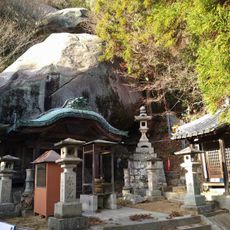
Kakujō-in, Buddhist temple in Mitoyo, Japan
Kakujō-in is a Shingon Buddhist temple of the Omuro school in Mitoyo, Kagawa Prefecture, formally named Daineizan Fudō Gokokuji Kakujō-in. Its main image is a thousand-armed Kannon, and it is the 19th stop on the 33-temple Sanuki Kannon pilgrimage. The temple stands on the site of the former Nio Castle, and its bell tower, built between 1573 and 1614 in Momoyama style, is a nationally designated Important Cultural Property.
Founded in 819 by Kūkai (Kōbō Daishi) and first called Bodaishin-in, the temple was rebuilt during the Ōei era (1394–1427) by the monk Zōon. It burned in 1579 during the Chōsokabe clan's campaigns and was rebuilt again. In the Hōei era (1704–1710) it was moved to the site of Nio Castle and renamed Kakujō-in.
Kakujō-in is the 19th stop on the 33-temple Sanuki Kannon pilgrimage, and its main image is a Thousand-Armed Kannon. The temple belongs to the Omuro branch of Shingon Buddhism and is a special head temple (bekkaku honzan). Its full name is Daineizan Fudō Gokokuji Kakujō-in.
Kakujō-in stands on the site of the former Nio Castle, so the approach climbs to elevated ground rather than sitting on flat land. The temple is the 19th stop on the 33-temple Sanuki Kannon pilgrimage, 10.7 km from stop 18, Hōshaku-in, and 3.5 km from stop 20, Hōrin-ji. The bell tower, built between 1573 and 1614, is a designated Important Cultural Property.
The temple's bell tower, built between 1573 and 1614 in the Momoyama style, was designated a National Important Cultural Property on 26 February 1947. It is the one structure on the grounds singled out by the national government, and its designation predates most postwar heritage listings.
The community of curious travelers
AroundUs brings together thousands of curated places, local tips, and hidden gems, enriched daily by 94,576 contributors worldwide.