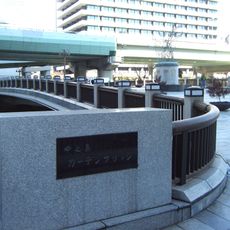
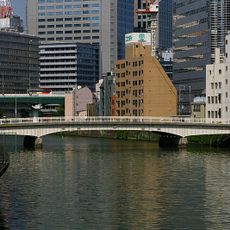
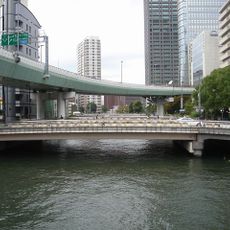
Nishiki Bridge, Pedestrian bridge in Kita-ku, Japan.
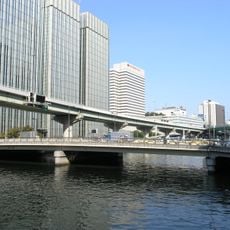
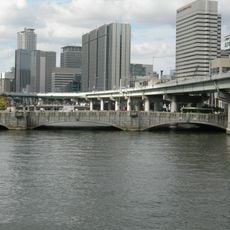
Nishiki Bridge is a pedestrian-only bridge over the Tosabori River, linking Edo-bori 1-chome in Nishi-ku with Nakanoshima 2-chome in Kita-ku. Its central two spans form a reinforced concrete arch about 15 meters long, flanked by concrete arches that incorporate the access stairs. The bridge stands just downstream of the Higo Bridge on Yotsubashi-suji.
Nishiki Bridge was installed in 1931 as one of six movable weirs built on Osaka's rivers, including the Tosabori, Dojima and Dotonbori. Its two central reinforced concrete arches, spanning about 15 m, once housed tainter and roller gates, taken out of service in 1978. It has always been a pedestrian-only bridge; the name Nishiki was given in 1985 when the deck was refurbished.
The bridge surface features ceramic tiles with ukiyo-e prints showing bridges from late Edo through early Meiji-period Osaka. These artistic decorations connect historical art traditions to the everyday experience of crossing the river.
The bridge spans the Tosabori River between Edo-bori 1-chome in Nishi-ku and Nakanoshima 2-chome in Kita-ku, just west of the Hugobashi bridge on Yotsubashi-suji. It has been pedestrian-only since it was installed, and the stairs on both sides are built into the concrete arches. The gates inside the arches stopped operating in 1978.
The bridge received a Handmade Hometown Award in 1986 for its architectural contributions. This recognition highlighted its role in preserving local heritage.
The community of curious travelers
AroundUs brings together thousands of curated places, local tips, and hidden gems, enriched daily by 93,507 contributors worldwide.