Tura-khan Mausoleum, Medieval mausoleum ruins in Chishminsky District, Russia.
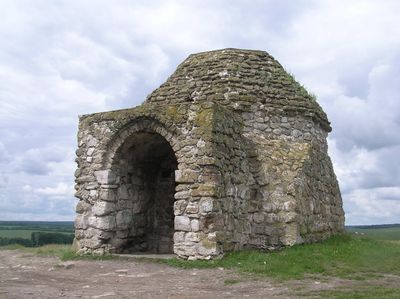
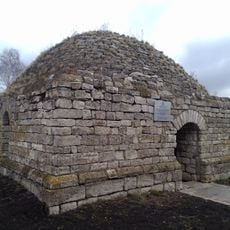
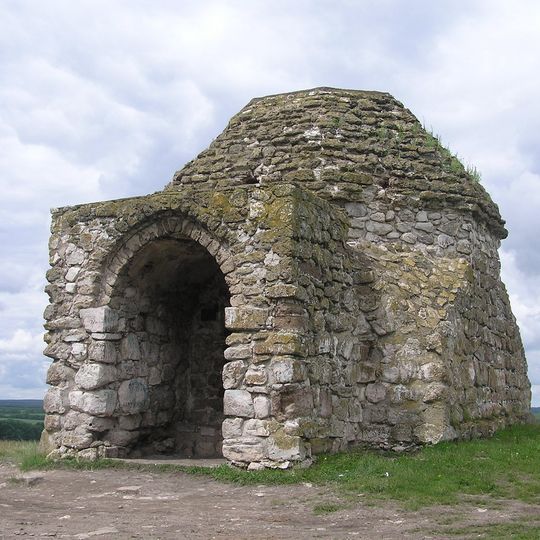
Tura-khan Mausoleum is a portal-domed stone tomb from the 14th–15th centuries near the village of Nizhniye Termy. Its walls of roughly dressed white stone, over one metre thick, enclose a square interior of 6.6 by 6 metres, and the dome rises above 7 metres. The east-facing entrance arch opens into a dark chamber; the upper part steps inward to a tent-like stone roof.
Built in the 14th–15th centuries, the mausoleum belongs to the Bulgar school of Golden Horde architecture. The name Tura-khan appears only in the 1860s, when G. Ignatovich, drawing on a Tatar chronicle, described a Chinggisid who quarrelled with Khan Kuchum and settled by the Slak river. Scholars now consider Tura-khan a title rather than a historical person.
The name Keshane comes from the Tatar words keshak (dust, ashes) and khane (house, from Persian), meaning "house of ashes". The name Tura-khan is considered a title rather than a historical person. A flat stone by the outer wall bears Kufic Arabic script naming Khan's wife Sakhibyamal, buried here.
The mausoleum stands on a low hill about 100 m off the road as you approach Nizhniye Termy, visible from a distance in open ground with no forest around. From Ufa it is about 50 km to the Chishmy settlement and roughly 10 km further to the village. The structure is enclosed by an iron grille and its entrance has a locked grille door, so it is viewed from outside.
In 1920 Gabdelakhat Vildanov found the painted digits "788" on a wall corner; read as a date they give 1386, or 1482 if written left to right. In 1936 Alexander Chuloshnikov compared the collapsed top of the dome to the crown of a Bashkir yurt. A flat stone by the outer wall, its Kufic Arabic inscription nearly worn into the ground, marks the grave of the khan's wife Sakhibyamal.
The community of curious travelers
AroundUs brings together thousands of curated places, local tips, and hidden gems, enriched daily by 93,359 contributors worldwide.