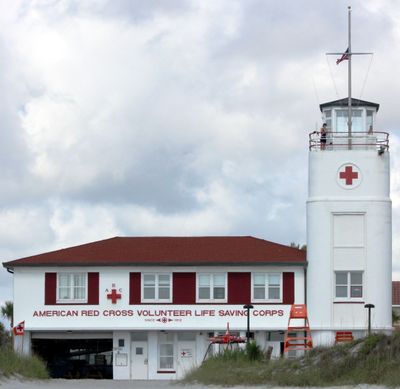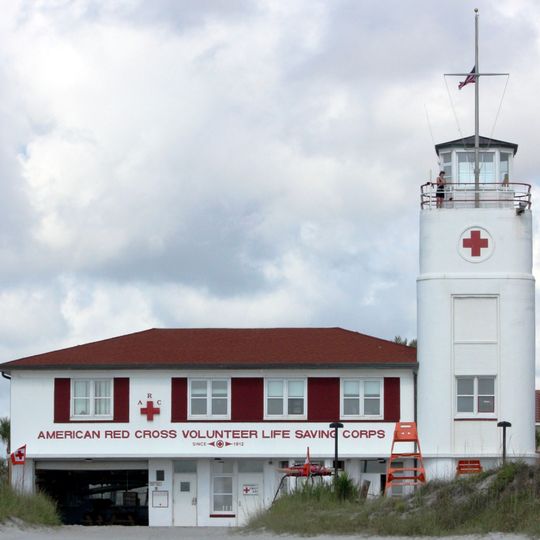
American Red Cross Volunteer Life Saving Corps Station, historic building in Jacksonville Beach, Florida, USA
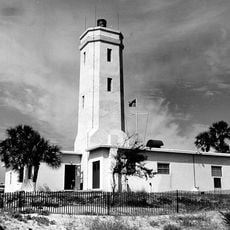
The American Red Cross Volunteer Life Saving Corps Station is a functional building built in 1948 in Jacksonville Beach that served as a base for volunteer lifeguards. Designed in Art Deco style by Jefferson Davis Powell, it features an observation tower five stories tall and sits close to the ocean for quick access to the water.
The organization was founded in 1912 when Clarence H. McDonald and Dr. Lyman G. Haskell established the United States Volunteer Life Saving Corps after a young nurse drowned, revealing the need for trained rescuers. The current building opened in 1948, replacing earlier wooden and concrete block structures that had served the growing community since 1913.
The station became a symbol of community care and safety for Jacksonville Beach residents and visitors. Local volunteers in their red suits represented a grassroots commitment to protecting swimmers and fostering a culture of lifesaving that shaped how the beach community viewed water safety.
The station sits close to the oceanfront and is easy to find while walking along Jacksonville Beach. Visitors should know this remains an active facility where lifeguards and volunteers work, so visits should be respectful and unobtrusive to their daily operations.
This station stands as the last of its kind in the United States still operating as a volunteer lifesaving organization. The volunteers have logged nearly 1.3 million hours of service over their history, completing more than 1,400 rescues and nearly 1,800 assists to swimmers in distress.
The community of curious travelers
AroundUs brings together thousands of curated places, local tips, and hidden gems, enriched daily by 91,679 contributors worldwide.