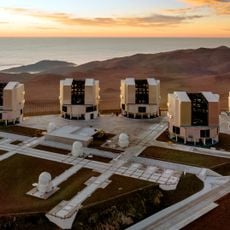
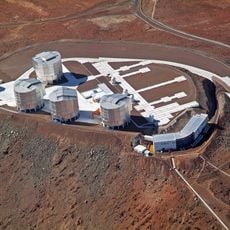
Cerro Murphy Observatory, Astronomical observatory in Antofagasta Region, Chile.
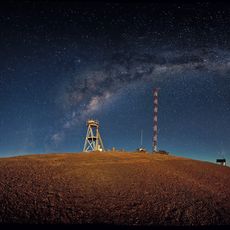
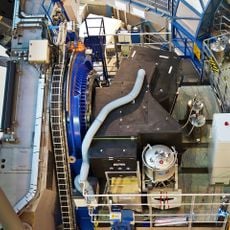
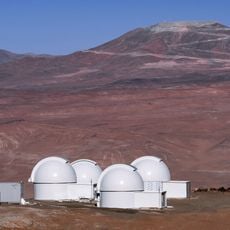
Cerro Murphy Observatory is an international astrophysical facility on Cerro Murphy, a hill 1 km southwest of and 230 m below the Cerro Armazones summit in Chile's Antofagasta Region. At 2,817 m altitude it houses five telescopes with mirrors between 0.3 and 1.5 m across, run by the Nicolaus Copernicus Astronomical Center under the Araucaria Project.
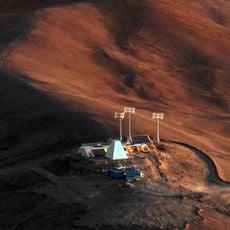
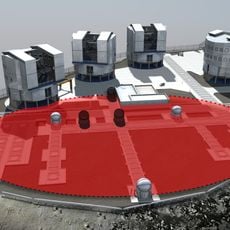
Construction began in 2005 by cutting the hilltop flat, and the observatory was inaugurated on 28 September 2006 as the Observatory Cerro Armazones, designed for three telescopes. Run jointly by Ruhr University Bochum and the Catholic University of the North, it passed to the Nicolaus Copernicus Astronomical Center in 2020 and was renamed the Rolf Chini Cerro Murphy Observatory on 28 November 2023.
Scientists from Chile, Poland, the United States, and European countries conduct research at the observatory to measure the expansion rate of the universe.
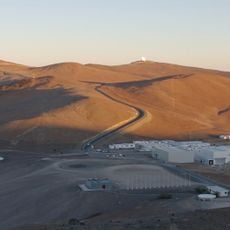
The observatory is a research site on Cerro Murphy, 1 km southwest of and 230 m below the Cerro Armazones summit, at 2,817 m altitude, 120 km south of Antofagasta. It is hosted on ESO's Paranal land and run by the Nicolaus Copernicus Astronomical Center; access is for scientific work, not public tours. The site was chosen on a lower, less windswept hill after wind measurements ruled out the summit.
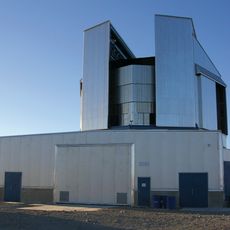
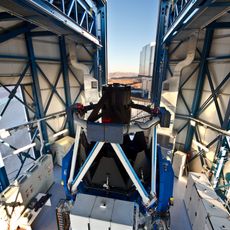
The 1.5-metre Hexapod-Telescope installed in 2006 took its name from its mount: six high-precision struts holding the platform to which the telescope is fixed. It was decommissioned by 2017 for lack of spare parts and replaced in 2019 by a robotic 30 cm Zeiss refractor from Potsdam supporting the PLATO satellite mission.
The community of curious travelers
AroundUs brings together thousands of curated places, local tips, and hidden gems, enriched daily by 94,170 contributors worldwide.