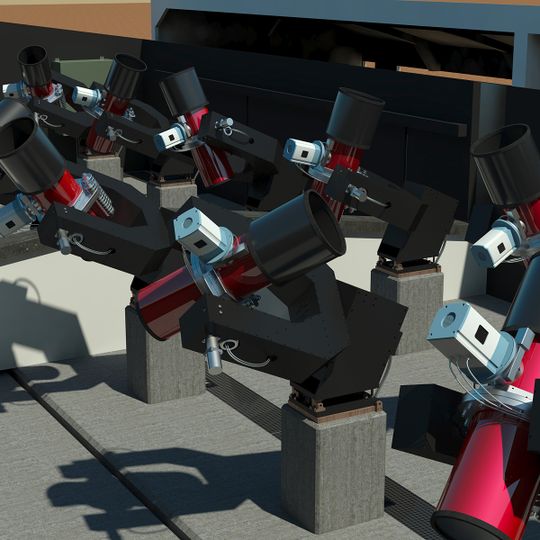
Next-Generation Transit Survey, Optical telescope at Paranal Observatory in Antofagasta Region, Chile
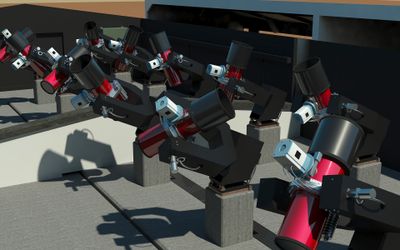
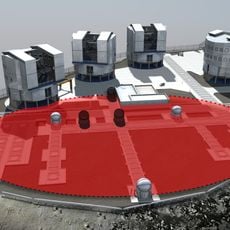
The Next-Generation Transit Survey is a robotic array of twelve 0.2-metre f/2.8 telescopes on independent equatorial mounts at the Paranal Observatory in the Atacama Desert. Each unit carries a red-sensitive CCD camera working at 600–900 nm. The photograph shows six of the units, each on a square grey concrete pier, with a deep red tube under a black hood and a white camera box on the mount.
The facility began operations in 2015 after testing phases at other locations had been completed. Multiple European and Chilean institutions came together to develop and operate this astronomical project.
Seven European universities and academic institutions from Chile, Germany, Switzerland, and the United Kingdom collaborate to manage this astronomical research project.
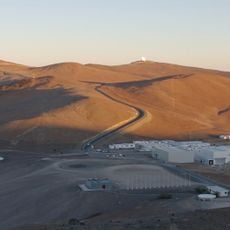
NGTS is a robotic facility and is not open to visitors; the array stands at Paranal Observatory in the Atacama Desert, about 2 km from ESO's Very Large Telescope and 0.5 km from the VISTA Survey Telescope. It is managed by a consortium of seven institutions from Chile, Germany, Switzerland and the United Kingdom, not by ESO.
The array's twelve telescopes each cover 8 square degrees, giving 96 square degrees at once, about 0.23% of the sky. Simulations predicted about 231 Neptune-sized and 39 super-Earth-sized planets suitable for spectrographic analysis by the VLT, against 21 and 1 from Kepler data.
The community of curious travelers
AroundUs brings together thousands of curated places, local tips, and hidden gems, enriched daily by 93,562 contributors worldwide.