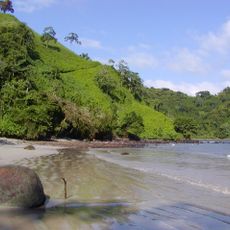
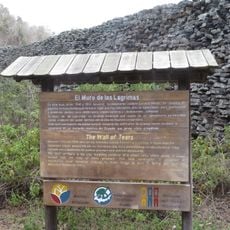
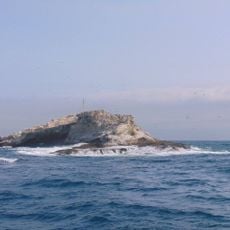
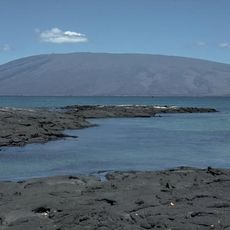
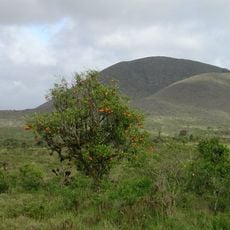
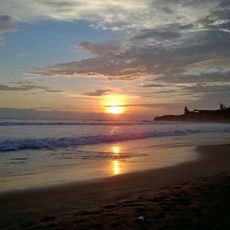
Volcán Ecuador, Dormant volcano on Isabela Island, Galápagos Islands, Ecuador.
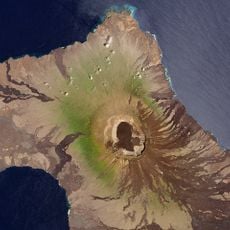
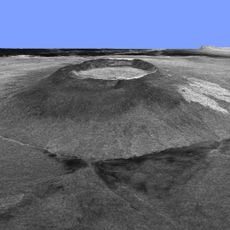
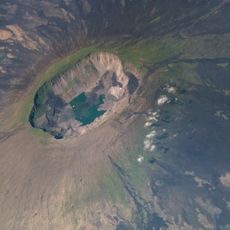
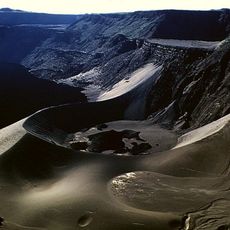
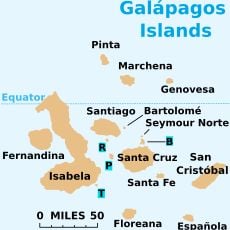
Volcán Ecuador is a shield volcano, the smallest of the six on Isabela Island, rising to 790 m (2,590 ft) in the island's northwest. Its caldera is breached to the west by edifice collapse, and the floor is largely covered by youthful lava flows with chains of spatter cones and small scoria cones. Cape Berkeley, on the west, lies on a tuff cone formed of young lava flows extending to the coast.
Volcán Ecuador is the smallest of the six shield volcanoes on Isabela Island. Its caldera is breached to the west by edifice collapse, and the youngest lava flows have a geomorphology comparable to very recent flows on other Isabela volcanoes. It is known to have erupted in or after 1150, and no eruption has been recorded since the islands were discovered in 1535.
The name "Ecuador" comes from the Spanish word for equator, which the volcano straddles like Volcán Wolf to the east. Unlike Isabela's other volcanoes, it has no population of giant Galápagos tortoises. Its caldera floor holds chains of spatter cones and small scoria cones that visitors can pick out from the rim.
Visitors need permits from the Galápagos National Park Service and must travel with certified guides to explore areas around the volcano. Access is only by boat and requires advance planning with local park operators.
The volcano sits near the equator, making it one of few places on Earth where magnetic forces from both hemispheres act with nearly equal strength. This special geographic position draws the interest of geophysicists and natural scientists worldwide.
The community of curious travelers
AroundUs brings together thousands of curated places, local tips, and hidden gems, enriched daily by 92,647 contributors worldwide.