Alcedo Volcano, Shield volcano in Isabela Island, Ecuador
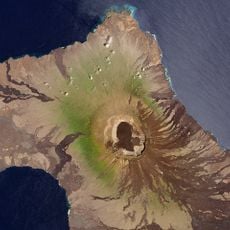
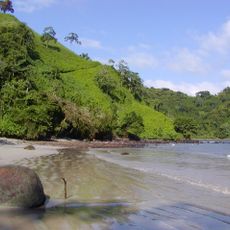
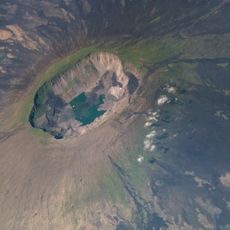
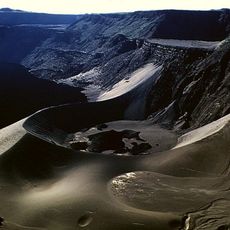
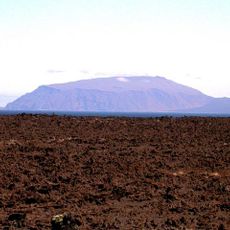
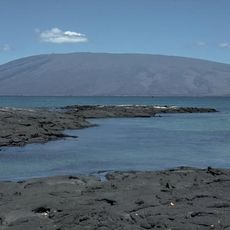
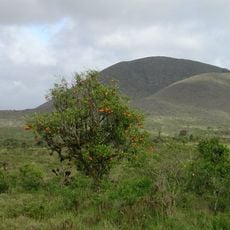
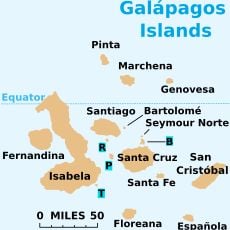
Alcedo Volcano is one of the six coalescing shield volcanoes that form Isabela Island. It rises 1,130 m and is topped by a caldera measuring 6.1 by 7.4 km, whose floor is less than 25% of the volcano's height. Its upper flanks, built of outward-dipping basalt flows at least 250 m thick, reach slopes of up to 33°.
Alcedo emerged from the sea about 313,000 years ago, based on its 234 km³ sub-aerial volume and an average eruption rate of 1 million m³ per year. Rhyolite eruptions began around 120,000 years ago, and the largest produced a tephra layer on the eastern slopes. The 1993 eruption was not observed and was only recorded in 1995 when an expedition found new craters.
Alcedo is named after Antonio de Alcedo, an 18th-century geographer of the Real Audiencia de Quito. Its slopes hold Chelonoidis vandenburghi, the largest wild tortoise population in the Galapagos, about 4,000 animals, though their genetic diversity is 3-5 times lower than other subspecies. Feral goats crossed the Perry Isthmus in the early 1970s and reached 75,000-125,000 by 1998; Project Isabela removed them all by 2006.
Alcedo has no visitor trail or tourist infrastructure; its caldera and tortoise habitat are reached only on foot through remote terrain, and access requires authorization from the Galapagos National Park. The 1993 eruption went unrecorded until an expedition found new craters in 1995, so conditions are checked on site rather than from published reports.
Alcedo is the only Galapagos volcano known to have erupted both rhyolite and basalt. About 1 km³ of rhyolite erupted from at least three vents in 2–5 episodes, and the most explosive produced a tephra layer covering the eastern half of the volcano. The 1993 eruption went unobserved and was only recorded in 1995, when an expedition found new craters.
The community of curious travelers
AroundUs brings together thousands of curated places, local tips, and hidden gems, enriched daily by 93,645 contributors worldwide.