Iglesia de San Agustín, Neoclassical church building in Santiago commune, Chile
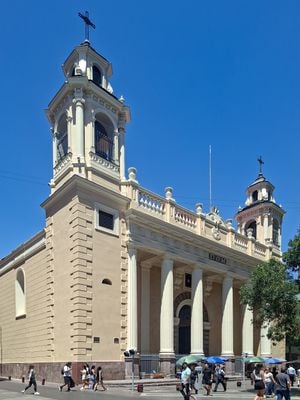
The Iglesia de San Agustín is a neoclassical church building in downtown Santiago with two towers and a facade featuring six Doric columns topped by an ornamental cornice. The interior houses religious artworks and sculptures arranged symmetrically within the space, reflecting the architectural style of its era.
Augustinian friars founded the convent on 31 March 1595 after arriving from Peru; construction of the present church began in 1608 under Our Lady of Grace. The 1647 earthquake destroyed two-thirds of the temple except the wall holding the Cristo de Mayo, prompting a procession still held today. Fermín Vivaceta added the neoclassical portico and towers from 1850.
The church serves as a spiritual gathering place where visitors encounter the carved wooden Christ figure that has been venerated by the local community for generations. This devotional focus shapes how people experience and remember the interior space.
The church occupies the southeast corner of Agustinas and Estado streets, with the entrance on Estado. The convent's former grounds once filled the whole block between Estado, Agustinas, San Antonio and Moneda; later construction replaced the old cloisters. The sources give no information on wheelchair access or visiting hours, so check locally before planning a visit.
In a side altar dedicated to Saint Rita of Cascia, not the main altar, the church keeps a relic of the saint: a small piece of bone. The Cristo de Mayo carving is linked to the 1647 earthquake, when the crown of thorns reportedly slipped to the statue's neck and stayed there.
The community of curious travelers
AroundUs brings together thousands of curated places, local tips, and hidden gems, enriched daily by 92,659 contributors worldwide.