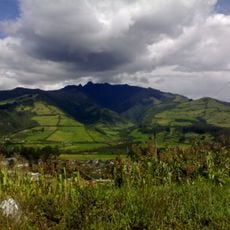
Volcano Atacazo, Stratovolcano in Western Cordillera near Quito, Ecuador.
Atacazo is a stratovolcano in the Western Cordillera of Ecuador, in Mejía Canton about 25 km southwest of Quito, reaching 4,463 m above sea level. It is a stratovolcano formed by the action of a Late Pleistocene to Holocene caldera. Its last eruption was nearly 2,300 years ago.
Atacazo is a stratovolcano built by a Late Pleistocene to Holocene caldera, and its last eruption occurred nearly 2,300 years ago. The mountain lies 25 kilometres southwest of Quito, in Cantón Mejía, and rises to 4,463 metres. On 7 November 1960 a Fairchild F-27 of AREA Ecuador struck the volcano in bad weather while approaching Quito's new Mariscal Sucre airport, killing all 37 people aboard.
The name Atacazo comes from the local toponymy recorded for this sector of the Western Cordillera, and the mountain appears on maps of the Mejía canton south of Quito. Visitors today see no built shrine on the summit; the volcano is a landmark of the high páramo above the villages of the canton, and its profile is used to orient walks and climbs in the area.
The mountain is reachable from Quito by organized tours or independently, but the trails demand proper mountain gear and enough time to adjust to the altitude before heading up. Weather changes quickly at this elevation, so starting early in the day gives the best chance of clear conditions.
In 1960, a plane crashed near the summit during poor weather in one of Ecuador's worst aviation disasters. The incident shows how the mountain's terrain and high-altitude winds can be dangerous not just for hikers but also for aircraft flying through the area.
The community of curious travelers
AroundUs brings together thousands of curated places, local tips, and hidden gems, enriched daily by 92,628 contributors worldwide.