Carondelet Palace, Presidential palace in historic center of Quito, Ecuador
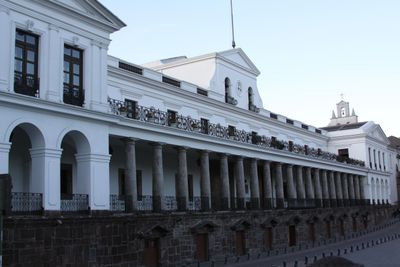
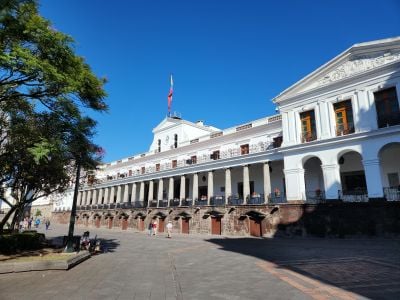
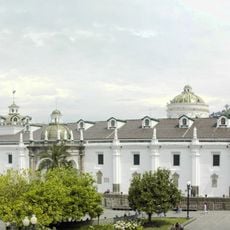
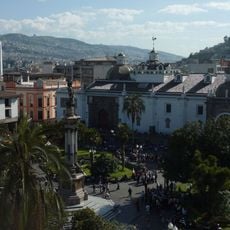
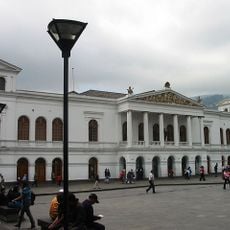
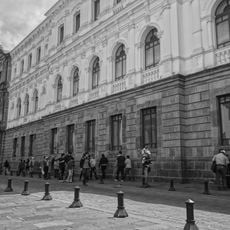
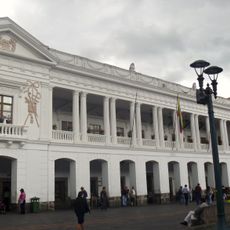
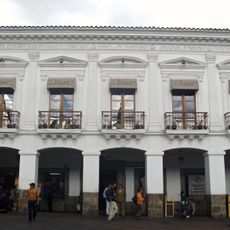
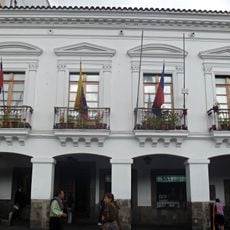
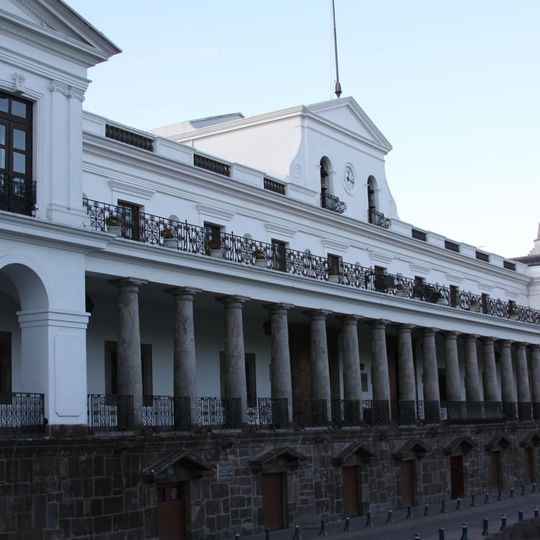
Carondelet Palace is a white building on Plaza Grande whose dark stone base has arched openings and small gabled doorways. Above it, a colonnade of tall cylindrical columns carries a balcony with black wrought-iron railings, and a triangular pediment with a clock face crowns the white upper wall. The palace and the adjoining Vice-Presidency occupy a block of about 80 m per side, some 6,400 m².
The first royal houses on Plaza Grande date to around 1570; after the 1627 earthquake they were rebuilt in stone, brick and lime, giving the white colour seen today. In 1801 the Baron of Carondelet hired Antonio García to renovate the palace and cathedral. The Act of Independence was signed in its halls on 10 August 1809, and the Spanish capitulation on 25 May 1822.
The name comes from Francisco Luis Héctor, Baron of Carondelet, who ordered the facade with its columned portico in 1801; tradition credits Simón Bolívar with the nickname, though official documents never used it. Gabriel García Moreno installed the public clock and three bells on the central pediment. Since 2007 the palace has housed a museum of presidential gifts, closed again under Lenín Moreno.
Access is limited to guided tours that must be arranged in advance. Visitors need to bring valid photo identification and should expect some areas may not be open to the public.
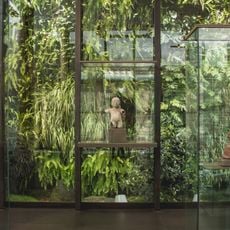
Most furniture and interior objects seen today are new; researcher María del Carmen Molestina found that bronze fittings from García Moreno's era were replaced with gold-sprayed lead copies. The palace was opened as a museum under Rafael Correa, then closed again under Lenín Moreno.
The community of curious travelers
AroundUs brings together thousands of curated places, local tips, and hidden gems, enriched daily by 92,560 contributors worldwide.