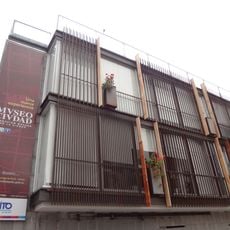
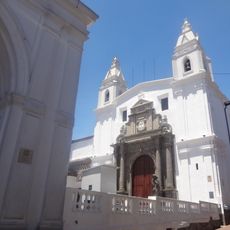
Palacio Arzobispal, Archbishop's palace in Plaza de la Independencia, Quito, Ecuador
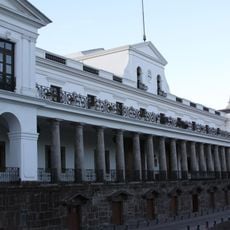
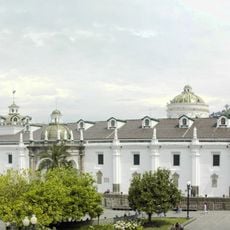
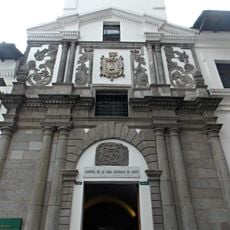
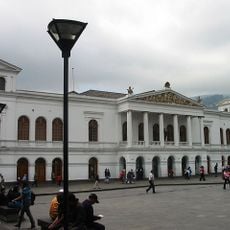
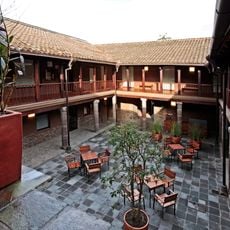
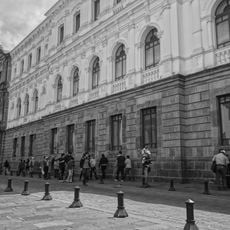
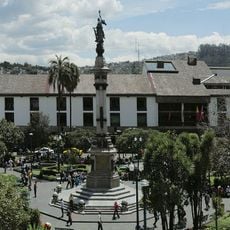
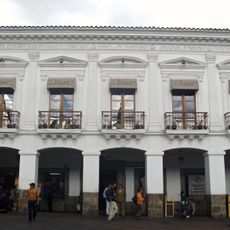
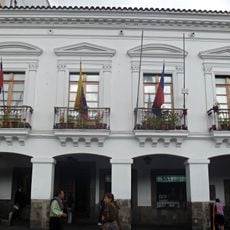
The Palacio Arzobispal stands at the eastern corner of Chile and Venezuela streets, on the north side of the Plaza de la Independencia. Its neoclassical facade has two solid end sections topped by triangular pediments carved with the Vatican arms on the right and those of the Archdiocese of Quito on the left, joined by a covered balcony gallery with a double colonnade of cylindrical shafts and Ionic capitals. A covered arcade runs along the ground floor; inside, a vestibule leads to a large stone courtyard with a carved stone fountain, surrounded by four two-storey wings.
The palace traces its origin to the 1546 erection of the Bishopric of Quito, when the lot of conquistador Núñez de Bonilla on the northeast corner of the Plaza Mayor was bought for the bishop's residence. In 1775 the Spanish architect Antonio García, also involved in the Palacio de Carondelet, added neoclassical forms with triangular pediments and reliefs of the Vatican and Quito archdiocese arms. A 1978 intervention reinforced the structure and updated electrical and sanitary systems.
The archbishop's offices on the second floor of the western wing are open to the public, while the adjoining archbishop's chapel is restricted to commercial, liturgical and ecclesiastical authorities. That chapel holds works of the Quito School of art from the 16th to the 19th century. The archdiocesan archive dates from 1545 and is organised in 15 sections, from Sacred Orders to Confraternities and Parish Inventories.
The palace stands at the eastern corner of Chile and Venezuela streets, on the north side of the Plaza de la Independencia. Entry to the archbishop's offices and the adjoining diocesan offices on the upper floor is open to the public. The archbishop's chapel, in the western wing, is restricted to commercial, liturgical and ecclesiastical authorities.
The archbishop's private chapel, closed to the general public, holds works of the Quito School of art from the 16th to the 19th century. The palace archive dates back to 1545, the year the diocese was erected, and is organised in 15 sections, from Sacred Orders to Confraternities and Chaplaincies.
The community of curious travelers
AroundUs brings together thousands of curated places, local tips, and hidden gems, enriched daily by 92,635 contributors worldwide.