Castillo de Piria, Renaissance house in Piriápolis, Uruguay.
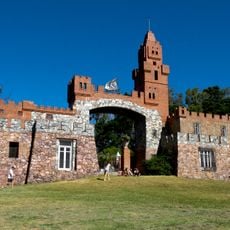
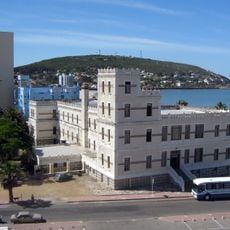
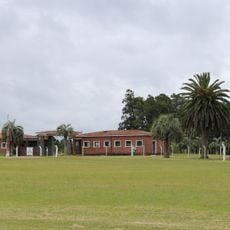
Castillo de Piria is a rectangular brick building near Piriápolis, begun in 1894 to a design by engineer Aquiles Monzani and inaugurated on 17 August 1897. Its corners end in circular turrets, and the main entrance is flanked by grey granite columns quarried at Cerro Pan de Azúcar, with terracotta hounds on either side of the carved gate. Inside are two floors and a basement, Piria's former alchemy laboratory, closed to the public.
Francisco Piria bought 2,700 hectares from the heirs of General Leonardo Olivera around 1890, after a 1889 trip to Europe turned his attention to the eastern coast. Construction of the residence began in 1894 to a design by engineer Aquiles Monzani, and Piria inaugurated it on 17 August 1897. In 1975 it was sold to the Comas Amaro family, and in 1980 the Maldonado municipal government acquired and restored it as a museum.
The park holds terracotta works by Tomaso Airaghi and a bronze "Mercurio en descanso" by Giovanni Di Bologna, an exact replica of the statue found at Herculaneum. Scattered among the trees are amphoras, pelicans, fountains and alchemical symbols chosen by Piria. Across Route 37 stands his winery, where vines imported from Italy and France produced the liqueur he called cognacquina.
The building now functions as a museum where visitors can explore its architecture and interior spaces. It sits centrally in Piriápolis and is easily accessible on foot from the town center.
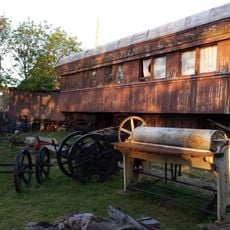
The basement, closed to the public, held Francisco Piria's alchemist laboratory. In the park stands an exact bronze replica of "Mercurio en descanso" by Giovanni Di Bologna, after the original found at Herculaneum, among terracottas by Tomaso Airaghi and a wagon from the Pitra train.
The community of curious travelers
AroundUs brings together thousands of curated places, local tips, and hidden gems, enriched daily by 92,651 contributors worldwide.