Forte de D. Pedro II de Caçapava, Military fortress in Caçapava do Sul, Brazil.
The Forte de D. Pedro II de Caçapava is a hexagonal stone fortification north of Caçapava do Sul, designed in 1850 by Captain José Maria Pereira de Campos. Its rough-stone walls rise 7.75 metres above the foundations, with pentagonal bastions at the six vertices and an outer perimeter of 611.70 metres, encircled by a dry moat.
In 1848, during tensions with Argentine leader Juan Manuel de Rosas, provincial president Soares de Andréa proposed fixed defences at key access points, including a battery at Caçapava. A light earthwork already stood on a hill north of the village. In July 1850, Captain José Maria Pereira de Campos designed a hexagonal stone fort with pentagonal bastions, walls 7.75 m high and a 611.70 m outer perimeter; work began that September.
The site is listed by IPHAN, Brazil's national heritage institute. Its dry moat and hexagonal rampart line, with pentagonal bastions at the vertices, can still be traced on the ground north of the town. The fort was planned as a 3rd Class stronghold with warehouses, depots, barracks and a hospital, a design that never left the drafting stage.
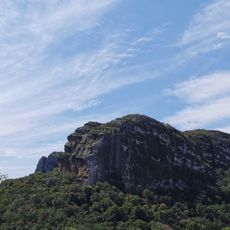
The fort stands on a hill north of the town, within cannon range and overlooking the old village. Its dry moat and hexagonal rampart of rough stone, 7.75 m high above the foundations, can be traced on foot; the perimeter measures 611.70 m. The site is listed by IPHAN.
The fort's hexagonal trace with pentagonal bastions was designed in July 1850 by Captain José Maria Pereira de Campos, who budgeted it at 80:789$162 réis. The land, bought from Joaquim Lourenço de Brito on 7 January 1851 for 1:155$000 réis, was occupied before formal purchase. The dry moat and 7.75-metre walls were meant to shelter the whole village in a retreat.
The community of curious travelers
AroundUs brings together thousands of curated places, local tips, and hidden gems, enriched daily by 92,744 contributors worldwide.