Moconá Waterfalls, Natural falls in Misiones Province, Argentina.
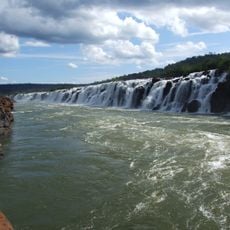
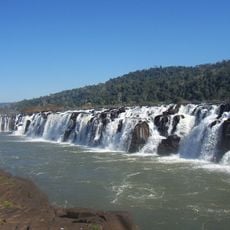
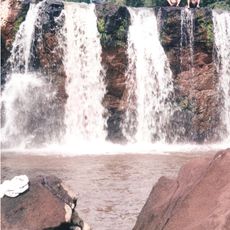
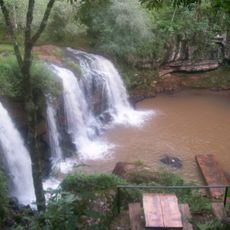
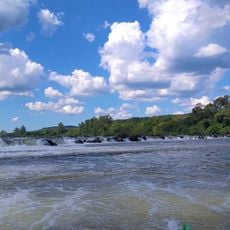
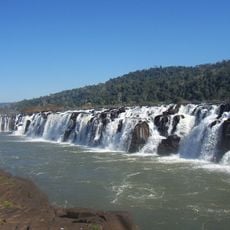
Moconá Waterfalls are a series of falls that run for three kilometers along the Uruguay River in Misiones Province, Argentina, where water drops between five and seven meters into a parallel canyon. The main flow occurs within a long fault in the riverbed, with the water level on either side of the crack differing in height.
The falls lie in a long geological fault that cuts the Uruguay River between the mouths of the Yabotí and Pepirí Guazú streams, reaching depths of up to 170 metres in places. In 1967 Juan Alberto Harriet donated 999 hectares for the Moconá reserve. The Moconá provincial park was created by decree in 1988, and national law 24288 of 1993 declared the stretch a national natural monument.
In Guaraní, Moconá means "that which swallows everything", a name given to the falls and the churning water at the foot of the drop. On the Brazilian side the same falls are called Salto do Yucumã, and the border between the two countries runs along the river's thalweg, so almost all of the falls lie on the Argentine side except the northern end. The area sits within the Yabotí Biosphere Reserve.
The falls lie 337 km from Posadas via Route 12, Provincial Route 7, National Route 14 and Provincial Route 2 along the Uruguay River; from the Mesa Redonda junction it is 18 km more. The falls are visible only when the river is low, so timing depends on the flow. Access is from El Soberbio on the Argentine side and Derrubadas on the Brazilian side.
Unlike conventional waterfalls that flow downward, the falls run parallel to the river course, creating a longitudinal water cascade. The falls are fully visible only when water levels are low, making them a weather-dependent natural phenomenon.
The community of curious travelers
AroundUs brings together thousands of curated places, local tips, and hidden gems, enriched daily by 92,774 contributors worldwide.