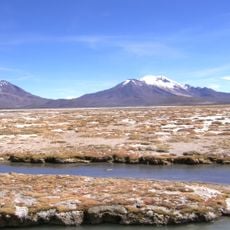
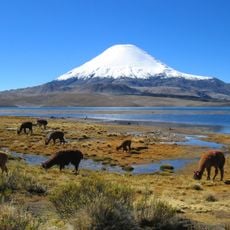
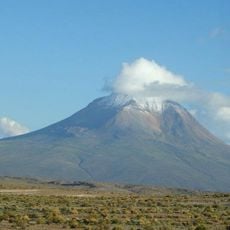
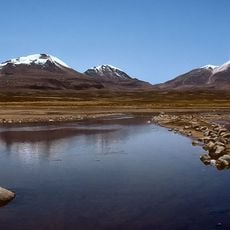
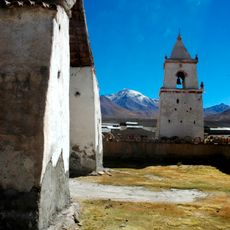
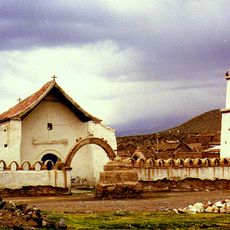
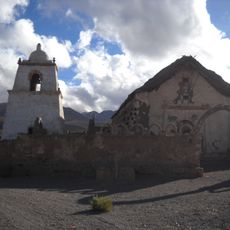
Pacha Qullu, Andean summit in Litoral Province, Bolivia.
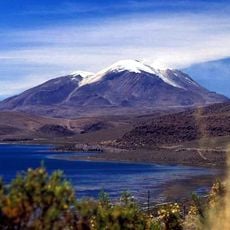
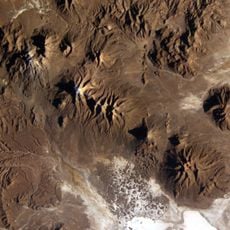
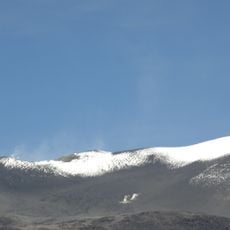
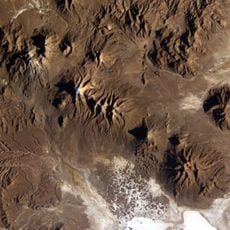
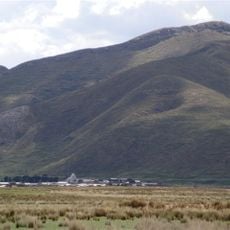
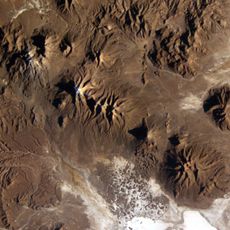
Pacha Qullu is a 4,702-metre volcano in the Andes of Huachacalla Municipality, Litoral Province, Bolivia, rising from a plain at about 3,700 metres beside Inka Qhamachu. Its slopes of 11–16° are built of lava flows and pyroclastic material, cut by radial gullies that end in alluvial fans. A sector collapse left a breach 2.4 kilometres wide and 4.7 kilometres long.
Pacha Qullu is a Pliocene-age volcano, roughly 8.3 million years old judging by its degree of erosion. It originally stood about 89 metres higher and had a volume of 37.4 cubic kilometres. A sector collapse later opened a breach 2.4 kilometres wide and 4.7 kilometres long, and erosion has cut radial gullies whose ends feed alluvial fans.
The name comes from the Aymara language, where 'pacha' means world or time and 'qullu' means mountain, showing the indigenous roots of the region. This linguistic origin reflects how local Andean peoples named and related to their natural surroundings.
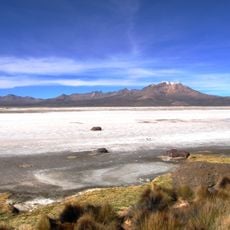
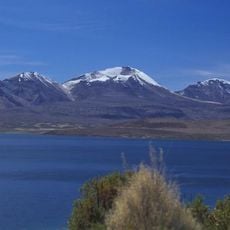
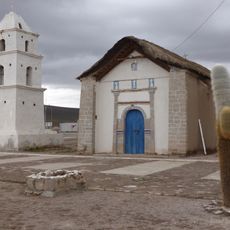
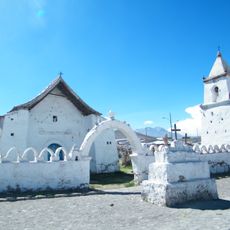
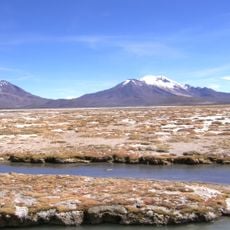
Pacha Qullu rises from a plain at roughly 3,700 metres to 4,702 metres, about 100 km west of Lake Poopó and 40 km north of the Salar de Coipasa. The nearest settlement is Huachacalla, with about 2,025 inhabitants, on the mountain's western edge. Winds are strong and vegetation is limited to shrubs and tussock grass, so plan for exposed, dry conditions.
The collapse left a breach 2.4 km wide and 4.7 km long on the volcano's flank. Erosion has since cut radial gullies whose lower ends open onto alluvial fans. The summit once stood about 89 m higher, with an original volume of 37.4 cubic kilometres.
The community of curious travelers
AroundUs brings together thousands of curated places, local tips, and hidden gems, enriched daily by 94,024 contributors worldwide.