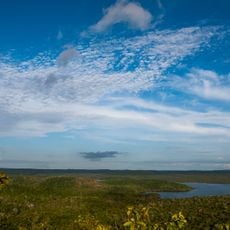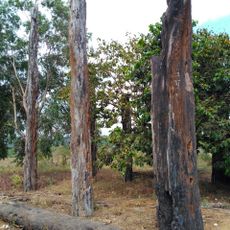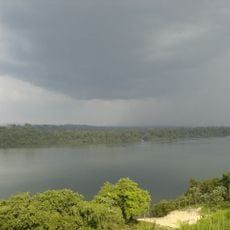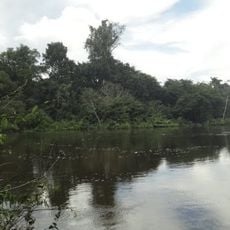
Caverna da Pedra Pintada, Archaeological cave in Monte Alegre, Brazil.
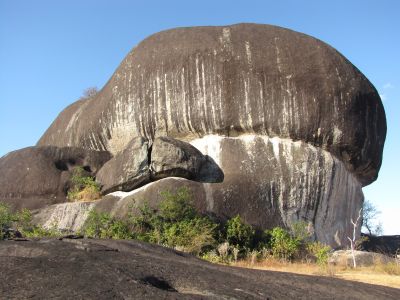
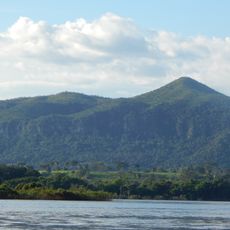
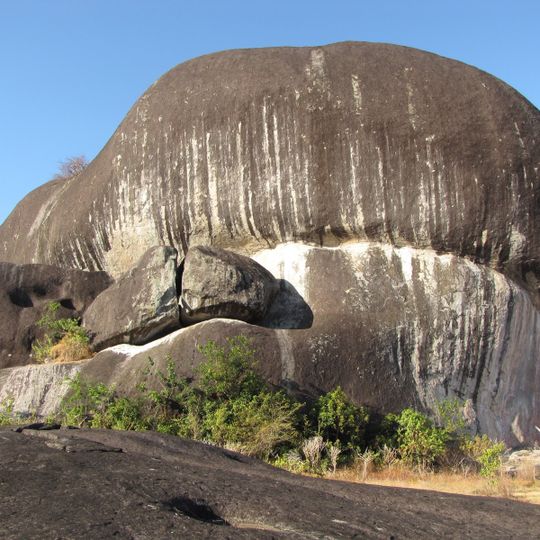
Caverna da Pedra Pintada is a cave in Monte Alegre State Park whose walls carry paintings in brown, red and yellow mineral pigments, including hand stencils, geometric designs and a stick figure of a woman giving birth. The site lies in a rounded rock outcrop marked by pale vertical streaks and a horizontal white band.
The cave was excavated between 1990 and 1992 by archaeologist Anna C. Roosevelt, who found evidence of human settlement dating back roughly 11,200 years. This discovery showed that the Amazon region was occupied much earlier than previously believed.
Researchers classify the rock art into two styles: Parime, which is abstract, and Surumu, which is naturalist. The paintings include a stick figure of a woman giving birth, geometric designs and hand stencils in browns, reds and yellows. Edithe Pereira of the Museu Goeldi has studied the art since the 1980s.
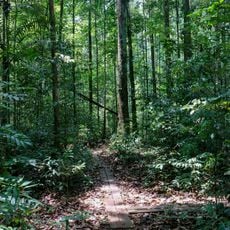
Access to the cave is through Monte Alegre State Park, a large protected area with trails and signage to guide visitors. Wear sturdy shoes since the path involves uneven terrain and natural obstacles.
The cave holds over 30,000 stone artifacts, showing that early inhabitants lived here for extended periods rather than passing through. This high density of objects makes it one of the most revealing sites for understanding early human settlement.
The community of curious travelers
AroundUs brings together thousands of curated places, local tips, and hidden gems, enriched daily by 92,892 contributors worldwide.