Marabá Combined Bridge, Railway and road bridge in Marabá, Brazil
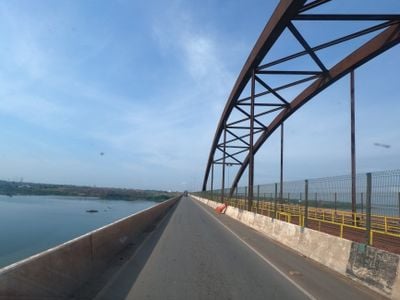
The Marabá Combined Bridge is a structure carrying both railway and road traffic across the Tocantins River. It uses the center section for train operations while vehicles travel on either side.
Construction began in late 1983 with surveys of possible crossing points, and work started in early 1984, finishing about a year later. Vale wanted a railway-only bridge, but the Ministry of Transport required future road use. The German firm Leonhardt-Andra's rail-only design was rejected; engineer Jayme Mason developed the final project. The consortium of Vale, DNER, Batter and Usimec built it, and President João Batista Figueiredo inaugurated it on 28 February 1985.
The structure connects southeastern Pará to the northern Brazilian coast, serving as a vital link between different regions and their communities.
The bridge handles daily traffic for trucks, cars, and trains moving simultaneously in separate sections. You can view the structure from the riverbanks or while crossing on foot or by vehicle.
The bridge has no expansion joints along its 2,340 metres; its deck is a steel box section with a prestressed concrete slab, precast in strips. The German firm Leonhardt-Andra first proposed an all-rail bridge, but the project was reworked by Brazilian engineer Jayme Mason.
The community of curious travelers
AroundUs brings together thousands of curated places, local tips, and hidden gems, enriched daily by 92,817 contributors worldwide.