Nyamuragira, Active shield volcano in Virunga Mountains, Democratic Republic of the Congo
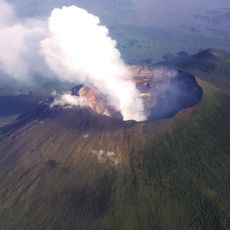
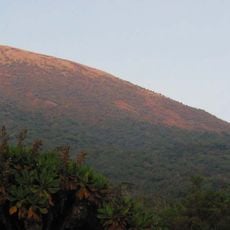
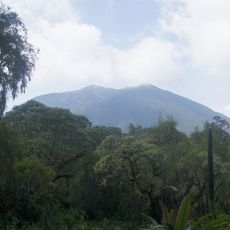
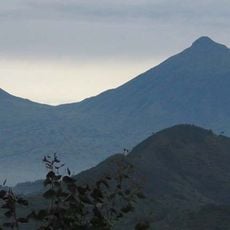
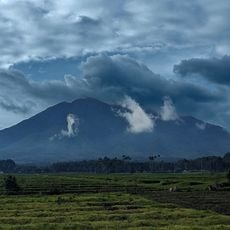
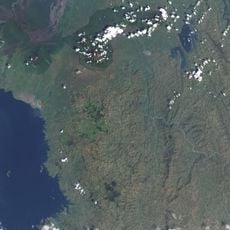
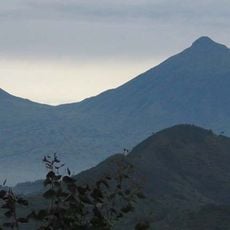
Nyamuragira is a shield volcano in the Virunga Mountains of the Democratic Republic of the Congo, rising 3,058 meters (10,033 feet) above sea level. Its summit crater measures roughly two by 2.3 kilometers (1.2 by 1.4 miles) and is surrounded by walls that reach up to 100 meters (328 feet) in height.
The first eruption observed by Europeans occurred in 1865. The eruption that ran from 1921 to 25 June 1940, interrupted between 17 and 28 January 1938, was the first to produce a lava lake in the caldera; it emitted about 330 million cubic metres of lava and caused a tsunami on Lake Kivu. Later lava lakes formed in 1948, 1951, 1976, 1986 and 2004.
The name Nyamulagira comes from the Mashi language of the Bashi people of the Kivu region, from the verb kulagiriza, "to cause suffering". Oral traditions record people crying "Rwamalagiriza" or "Namalagiriza" during eruptions, meaning "misfortune has befallen me"; the phrase evolved into Nyamulagiriza and then Nyamulagira, "the one who causes suffering".
The Observatoire Volcanologique de Goma issues regular reports on seismic activity and gas emissions that provide clues about potential hazards. Visitors should check these monitoring data, as conditions can change quickly.
The 2011 eruption produced a lava column that shot 400 meters (1,312 feet) into the air and was visible far beyond the surrounding area. Three years later, a new lava lake formed with a depth of 500 meters (1,640 feet), the first in 75 years in this crater.
The community of curious travelers
AroundUs brings together thousands of curated places, local tips, and hidden gems, enriched daily by 93,513 contributors worldwide.