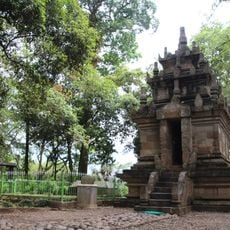
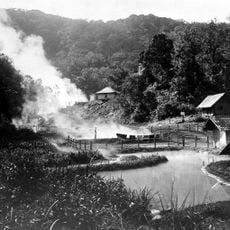
Bojongmenje, Hindu temple ruins in Rancaekek, Indonesia.
Bojongmenje is a Hindu temple ruin in Bojongmenje hamlet, Cangkuang village, Rancaekek, West Java, at 698 metres on the Priangan highland. Its square base, six metres on each side, is built of andesite blocks in a single wall layer without bas-relief or carving. Excavation revealed only the pedestal base.
In August 2002 a resident of Bojongmenje hamlet, digging soil to fill an uneven alley, struck a hollow surrounded by neatly stacked stones. Archaeologists identified the stones as part of a temple and began excavation a month later, exposing the base of the pedestal. Estimates place its construction between the 7th and 8th centuries, and geological study of the andesite suggests a range from the 5th to the 7th century.
Local residents found the stones in a cemetery behind a textile factory, and the site is still known as Situs Rancaekek. Its name links it to Kampung Bojongmenje in Cangkuang village. The temple is one of only a few Hindu-Buddhist monuments traceable in West Java, together with Candi Cangkuang and the Batujaya and Cibuaya sites.
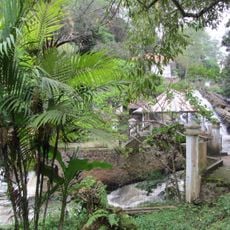
The site sits at a higher elevation than the coast, so the air tends to be cooler and the ground can be damp after rain. Having your own transport is the easiest way to reach Rancaekek and find the location.
The stone blocks were stacked without any mortar, held in place only by their own weight and the precision of their cut. The same dry-stacking technique appears in other early temples across Java, suggesting a shared building tradition in the region.
The community of curious travelers
AroundUs brings together thousands of curated places, local tips, and hidden gems, enriched daily by 93,660 contributors worldwide.