Demak Great Mosque, 15th-century wooden mosque in Demak, Indonesia
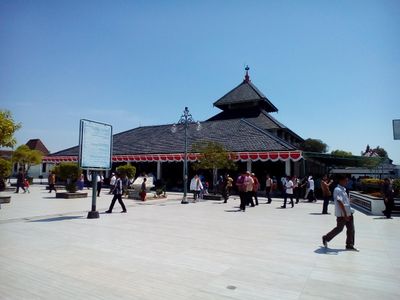
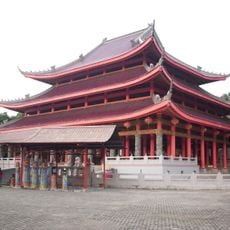
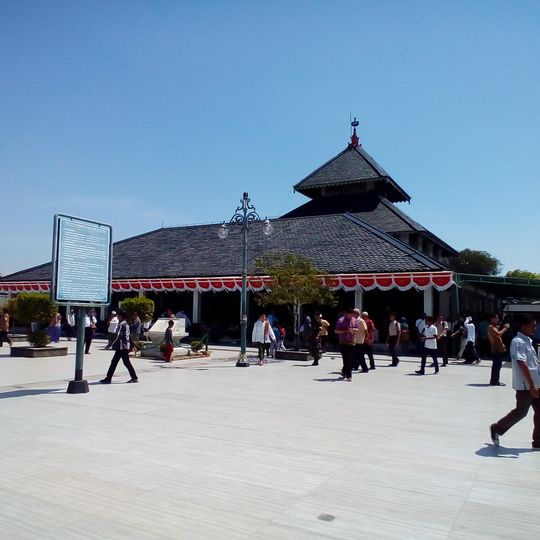
Demak Great Mosque is a timber mosque in the centre of Demak, Central Java, built in the traditional Javanese manner. Its steeply pitched roof rises in tiers to a pyramidal top crowned with a finial, above a broad facade with a red and white scalloped awning and a row of white pillars. Four saka guru teak pillars carry the roof, and a verandah, the surambi, was added in the nineteenth century.
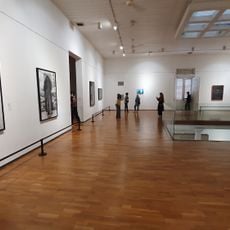
The mosque is believed to have been built by the Wali Songo, with Sunan Kalijaga as the most prominent figure, during the reign of Raden Patah, the first ruler of the Demak Sultanate, in the 15th century. A verandah, or surambi, was added in the 19th century; the building is otherwise thought to be largely in its original form. The complex holds the tombs of Demak sultans, including Raden Patah, and a museum on the mosque's founding.
The main entrance displays carved panels showing plants, vessels and crowns with local motifs such as the Lawang Bledheg pattern. Visitors today see worshippers still using this space for prayer while the carved panels show the meeting of Javanese and Islamic design.
The complex includes prayer rooms, a museum with collections and tombs of the sultans that are open daily. Visitors should wear modest clothing and be mindful of active prayer times to avoid disruption.
The walls carry Vietnamese ceramic tiles that imitate Persian mosque design and merge with Javanese wood carvings and brick patterns. This combination shows the far-reaching trade and cultural interweaving in 15th-century maritime Southeast Asia.
The community of curious travelers
AroundUs brings together thousands of curated places, local tips, and hidden gems, enriched daily by 94,043 contributors worldwide.