Goa Gajah, Ancient Hindu temple complex in Gianyar, Indonesia.
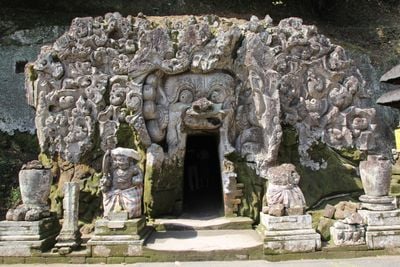
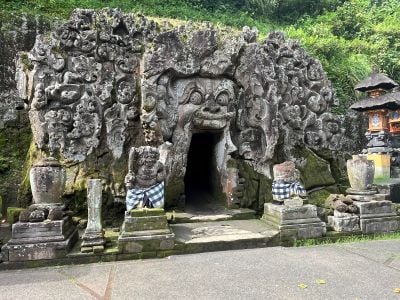
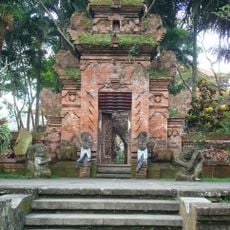
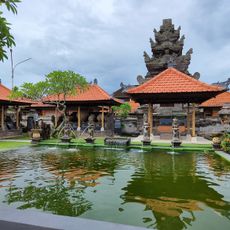
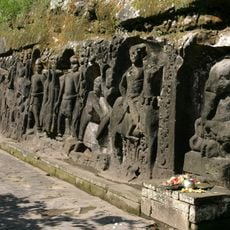
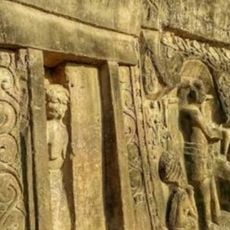
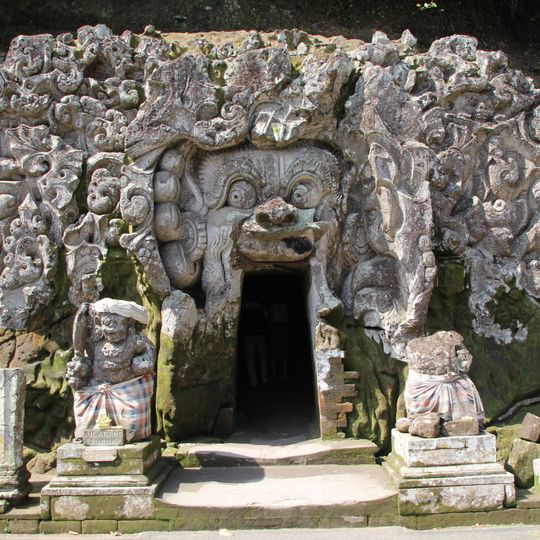
Goa Gajah is a 9th- to 11th-century sanctuary in Bedulu, Gianyar, centred on a cave carved into a rock face. Above the 1-metre-wide, 2-metre-high entrance, a menacing head with bulging eyes and an open mouth is surrounded by dense reliefs of leaves, rocks, demons, monkeys and pigs. Inside, a T-shaped passage runs 13.5 metres east-west, with seven niches; the east niche holds a trilingga and the west niche a Ganesha statue. In front, three bathing pools are flanked by six statues of women holding water pitchers.
The cave was carved into the rock face in the 11th century, as suggested by inscriptions on its east wall. It was rediscovered in 1923 by Dutch official L.C. Heyting, who reported a Ganesha statue, trilingga and Hariti statue. Excavations led by J.L. Krijgsman from 1954 to 1979 uncovered the bathing pools and six statues of women with water spouts.
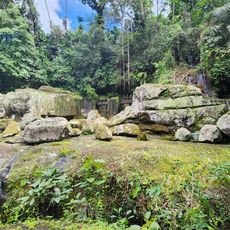
The name Lwa Gajah appears in the Kakawin Nagarakretagama, written by Mpu Prapanca in 1365; lwah means river, so it likely referred to the Petanu River in front of the temple. The bathing pools hold six statues of women with water spouts at the chest, each pair flanking a bather; the seventh is missing. Balinese know the Hariti statue here as Men Brayut.
The site is easily walkable and best visited in early morning hours to avoid crowds and enjoy good light for photography. Visitors should wear appropriate clothing that covers shoulders and knees out of respect for the cultural importance of the location.
The name Lwa Gajah appears in the Kakawin Nagarakretagama, written by Mpu Prapanca in 1365, where lwah means river, so it likely referred to the Petanu River in front of the temple. The modern name may come from the giant face above the cave mouth, read as an elephant, or from the Ganesha statue in a side niche.
The community of curious travelers
AroundUs brings together thousands of curated places, local tips, and hidden gems, enriched daily by 93,465 contributors worldwide.