Melbourne Observatory, Astronomical observatory in Victoria, Australia
Melbourne Observatory is an astronomical observatory complex in Victoria comprising several buildings arranged on a hill near the Royal Botanic Gardens. The facility houses the Main Observatory, Great Melbourne Telescope Building, Photoheliograph, and Magnet House, creating a scientific complex that once served multiple functions in astronomy and geophysical observation.
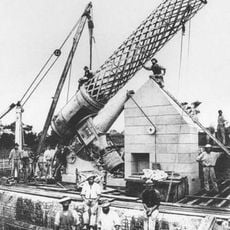
Melbourne Observatory was founded in 1862, after William Parkinson Wilson proposed it in a paper read to the Philosophical Institute of Victoria in 1856. The Victorian government tasked it with keeping an accurate time reference for the colony through transit-telescope star observations. A 48-inch Great Melbourne Telescope was installed shortly after founding. Control passed gradually to the Commonwealth after federation in 1901, and the observatory closed in 1945.
The Astronomical Society of Victoria keeps two original 1874 transit-of-Venus instruments on site: an 8-inch refractor by Troughton and Simms and a restored 4-inch photoheliograph by Dallmeyer, the latter privately owned and on indefinite loan. The building that held the 13-inch astrograph for the Carte du Ciel survey now houses the society's 12-inch Newtonian reflector.
The observatory sits on a hilltop near the Royal Botanic Gardens and is easily recognizable from the surrounding area. Observing conditions depend heavily on weather and clear skies, so checking conditions ahead of time helps you plan a visit when the night sky will be visible.
In 1874, the facility participated in coordinated international observations of the Transit of Venus, providing measurement data that later helped calculate the distance from Earth to the Sun. This collaborative effort demonstrated why Southern Hemisphere observatories were essential to solving one of astronomy's most pressing questions.
The community of curious travelers
AroundUs brings together thousands of curated places, local tips, and hidden gems, enriched daily by 93,374 contributors worldwide.