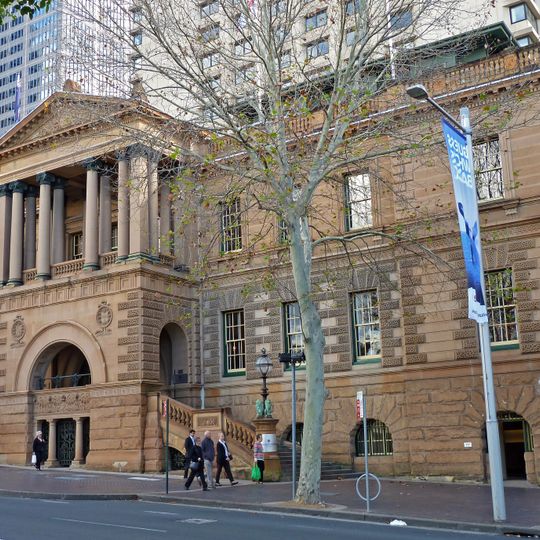
Treasury building, Sydney, Heritage government building in Sydney, Australia
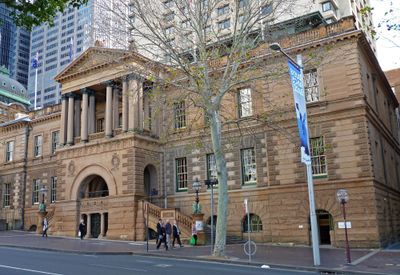
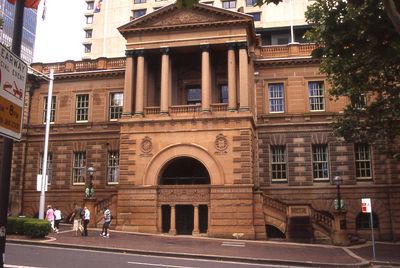
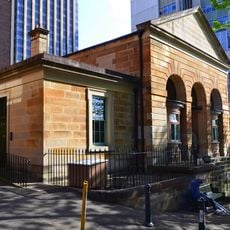
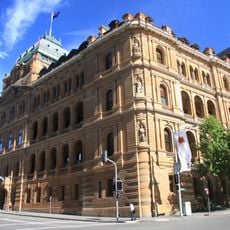
The Treasury Building stands at the junction of Macquarie and Bridge Streets, begun in 1849 by Colonial Architect Mortimer Lewis in the Italian Palazzo style, with a facade modelled on London's Travellers' Club of 1829. Its sandstone elevations show a rusticated base, a Macquarie Street portico with a triangular pediment on tall columns, and a round-headed archway above a balustraded balcony. Edmund Blacket, Walter Liberty Vernon and George McRae added to it in stages to 1919; since 1981 it has formed part of the InterContinental hotel complex.
Commissioned in 1849 from Colonial Architect Mortimer Lewis in the former garden of First Government House, the building opened in 1851 with separate Bridge Street and Macquarie Street frontages for the Audit Office and Treasury. Edmund Blacket added stables by 1853; Walter Vernon built the fire-proof Strong Room in 1896–1898 and the Macquarie Street portico in 1898–1900; George McRae extended the Bridge Street wing in 1916–1919. Sold in 1981, it became part of an InterContinental hotel complex.
The building's name recalls its original occupants: the Colonial Treasury and the Audit Office, split by an interior dividing wall until 1873, when the Treasury took over the auditors' rooms. Its design drew closely on London's Travellers' Club of 1829 in Pall Mall, a model a visitor can compare with the facade facing Bridge Street.
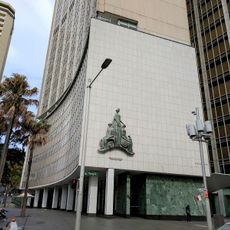
The building stands at the junction of Macquarie and Bridge Streets, and its heritage sections now form part of the InterContinental Sydney complex, so the former government rooms are reached through the hotel's public areas. The Macquarie Street portico of 1898–1900, with its four-column pediment, is the most visible face from the street.
Walter Liberty Vernon added a fire-proof Strong Room for state documents in 1896–1898, north of Blacket's stables, and linked it to the Lewis building by a Macquarie Street wing in 1898–1900. Its space was filled in during the 1940s, but archaeological work in 1983 uncovered remains of the 1850s stable block on the site.
The community of curious travelers
AroundUs brings together thousands of curated places, local tips, and hidden gems, enriched daily by 93,698 contributors worldwide.