Cox's Road and Early Deviations - Woodford, Appian Way Precinct, Heritage road site in Blue Mountains, Australia.
Cox's Road and Early Deviations – Woodford, Appian Way Precinct is a surviving section of the 1814 convict-built Bathurst Road, now an access road off The Appian Way near Woodford. It appears as a cleared band of flat sheet-stone pavement curving between deep railway and highway cuttings, with a rock cutting up to 1 metre high showing chisel and pick marks and thin 2-centimetre-wide semi-circular shafts.
William Cox and thirty convicts completed this road in 1814 under Governor Macquarie's directive to connect inland regions with the coast. The project opened the Blue Mountains area to further settlement and trade.
The name Cox's Road honours William Cox, the Windsor chief magistrate whom Governor Macquarie appointed superintendent of the mountain road works in July 1814. The route also carries the names Bathurst Road and Old Bathurst Road. Its line crosses the traditional lands of the Dharug, Gundungurra and Wiradjuri peoples, whose own routes over the Blue Mountains had been used for tens of thousands of years before the 1813 First Crossing.
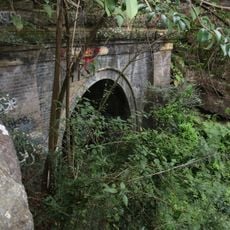
The surviving 1814 section lies west of The Appian Way, enclosed by deep railway and highway cuttings, and is now within operational railway land rather than a public walking trail. The eastern end is cut off by The Appian Way (1912) and the western end by an 1896 railway cutting. Access is restricted; the road is best seen from adjacent public vantage points.
Natural rock formations were incorporated directly into the road surface as pavement, showing how builders adapted to the mountainous terrain. This practical approach saved materials while using the existing stone efficiently.
The community of curious travelers
AroundUs brings together thousands of curated places, local tips, and hidden gems, enriched daily by 93,897 contributors worldwide.