Mount Tibrogargan, Volcanic mountain in Glass House Mountains National Park, Queensland, Australia.
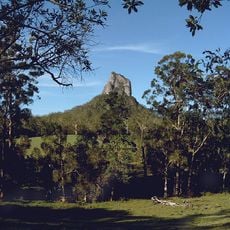
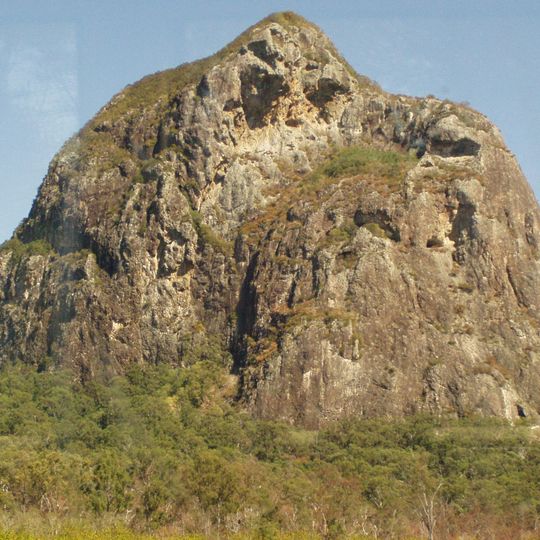
Mount Tibrogargan is a 364-metre magma intrusion of hard alkali rhyolite in Glass House Mountains National Park, north-northwest of Brisbane. Its steep dome-shaped mass has deep vertical crevices and dark streaks, with green vegetation clinging to lower slopes and crevices while the upper face stays mostly bare rock. The peak is the third tallest of the Glasshouse Mountains, 192 metres shorter than Mount Beerwah.
The mountain formed about 27 million years ago from ancient volcanic activity as a magma intrusion of hard alkali rhyolite rock. These geological origins continue to shape the peak's appearance and structure today.
The name Tibrogargan comes from the Aboriginal words chibur, flying squirrel, and kaiyathin, biting. In the region's mythology Tibrogargan is the father of all the Glass House Mountains except Beerwah, his wife; seeing a flood rise from the sea, he called on his son Coonowrin to carry Beerwah to safety, and when Coonowrin failed he clubbed him and broke his neck. Tibrogargan is said to have turned his back on Coonowrin.
The summit scramble leaves from the carpark at the mountain's base and follows a well-worn path on the SW shoulder; it is straightforward if near-vertical rock and heights do not deter you, and needs no abseiling. Rock climbers use free routes on the eastern side, from beginner to expert, single and multi-pitch. Easier options are the 3.3 km Tibrogargan Circuit and the 5.6 km Trachyte Circuit.
In 2004, natural erosion significantly changed the mountain's appearance when rock sections resembling eye-like features broke away and fell. This process shows how nature continues to reshape this landscape over time.
The community of curious travelers
AroundUs brings together thousands of curated places, local tips, and hidden gems, enriched daily by 92,664 contributors worldwide.