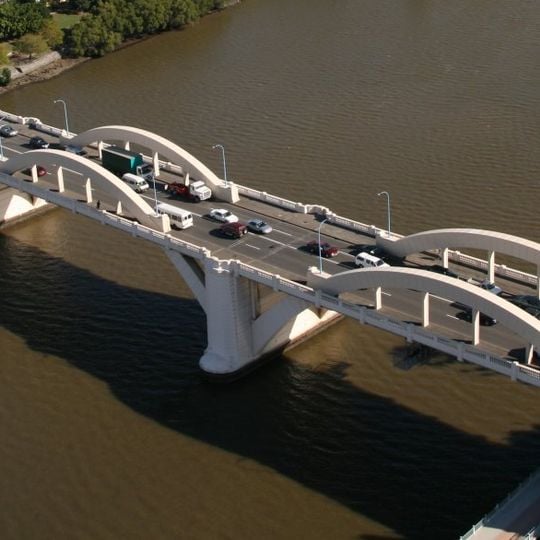
William Jolly Bridge, Heritage-listed arch bridge in Brisbane, Australia
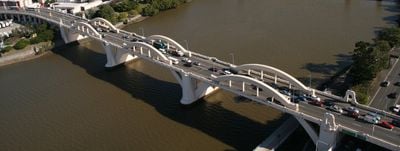
The William Jolly Bridge is a steel frame arch bridge with a concrete veneer finished to look like light-coloured porphyry, carrying a flat roadway between North Quay and Grey Street. Its deck rests on two piers in the river and two bank pylons, forming three arches of 72 metres each. The photograph shows four arches: two large main spans and two smaller arches above them, with a solid parapet and overhead lamps along the roadway.
Construction finished in 1932, making it one of the first major infrastructure projects completed after Greater Brisbane was formed. Built during a global economic downturn, the bridge helped connect the growing center with its southern suburbs more firmly.
The bridge spans a traditional river crossing that served Aboriginal people and early European settlers before modern infrastructure developed. Today it remains a familiar landmark where locals and visitors move through daily, experiencing a key connection point in the city's life.
Visitors can walk or cycle across the bridge, with dedicated paths on both sides for movement. The best time to explore is outside rush hours when traffic is lighter and you can observe the structure more easily.
The concrete surface is a veneer over a steel frame, treated to look like light-coloured porphyry. The design by Harding Frew was called the rainbow arch type and claimed as the first of its kind in Australia. The bridge was renamed on 5 July 1955 after William Jolly, the first Lord Mayor of Greater Brisbane.
The community of curious travelers
AroundUs brings together thousands of curated places, local tips, and hidden gems, enriched daily by 92,724 contributors worldwide.