El Teúl, Archaeological site in Zacatecas, Mexico.
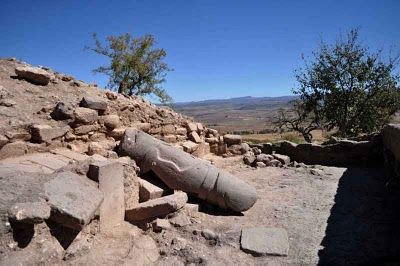
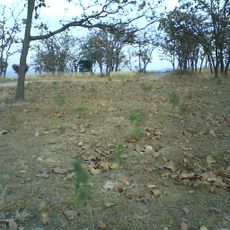
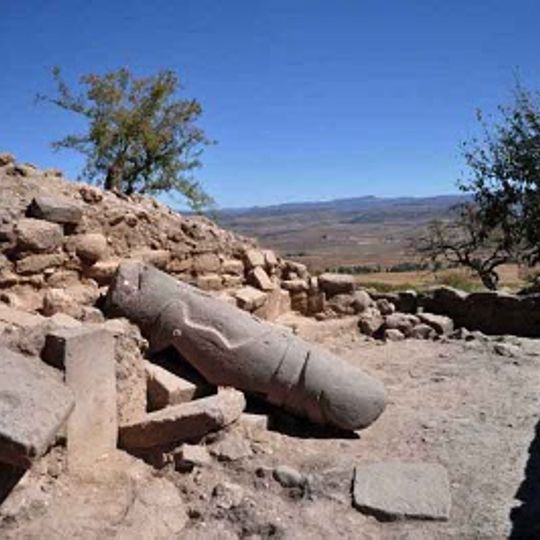
El Teúl is an archaeological site on a hilltop in the Mexican state of Zacatecas, featuring terraced levels with pyramids, a ball court, and a sunken ceremonial plaza. The site sits on the Cerro del Teúl and can be seen from the surrounding plateau.
The site was continuously occupied over many centuries by successive groups, which established it as a major ceremonial center for the surrounding region. Archaeological work that began in the late 20th century uncovered multiple building phases, showing how each group modified the existing structures.
The site's name comes from the Caxcan, who had El Teúl as one of their main population and religious centres; the word caxcan means 'there is no', reportedly because locals answered the Spaniards' requests for food with that phrase. Caxcan warriors led by Tenamaxtli fought under the cry 'Ashcanquema tehual nehual' ('until your death or mine'). Excavations have yielded shell beads from shaft tombs, green-stone pieces, ear ornaments with Teotihuacan motifs and Codex-style polychrome pottery.
The site lies on the Cerro del Teúl hill in the municipality of Teúl, southern Zacatecas, close to the Jalisco border. The climb follows the hill's slope, so allow time for the ascent and wear footwear suited to uneven ground. The excavated objects, including shell beads from shaft tombs and Codex-style polychrome ceramics, are not kept in an on-site museum.
Beneath one of the pyramids, a water conduit carved into rock was found in the shape of a serpent, linked to deities of the mythological underworld. This system shows that water was not just used practically but was woven into the ceremonial architecture as something sacred.
The community of curious travelers
AroundUs brings together thousands of curated places, local tips, and hidden gems, enriched daily by 94,096 contributors worldwide.