Hollywood Tower, Residential tower in Hollywood, Los Angeles, US
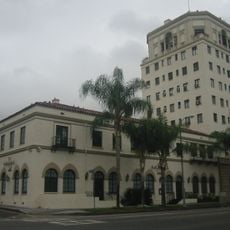
The Hollywood Tower is a seven-story V-shaped apartment building at Franklin and Vista Del Mar, designed by Cramer & Wise in a faux French Normandy style. Its lower section is a broad cream-colored block with a grid of rectangular windows, some with green shutters or awnings; above rises a narrower cream-colored upper tower topped by a steep dark grey chateau-style roof. Blue letters reading "ac" are mounted near the top, and a white sign with blue lettering reads "HOLLYWOOD TOWER" at street level.
The building was erected in 1929 as housing for employees of the growing film industry in Los Angeles. It received designation on the National Register of Historic Places in 1988.
A plaque by the front door reads "Hollywood Tower. 1929. Sophisticated living for film luminaries during the 'Golden Age' of Hollywood." The building was long a favored residence for entertainment industry employees; actor George Raft owned an interest and lived there, and character actor Eugene Pallette was among the first residents, staying through the 1930s.
Visitors will find no public tours offered at this residential building, but its location near the Hollywood Freeway allows a quick view from the street. The neon signs are most visible at night, when they illuminate the building's silhouette.
The Hollywood Tower is often cited as the inspiration for Disney's Twilight Zone Tower of Terror attractions, which reuse the same classic sign and spiraling towers. The building also appears by name in the 1948 film Devil's Cargo and in Brian De Palma's 1984 Body Double.
The community of curious travelers
AroundUs brings together thousands of curated places, local tips, and hidden gems, enriched daily by 92,601 contributors worldwide.