Campo de Cahuenga, Historic district in Studio City, California
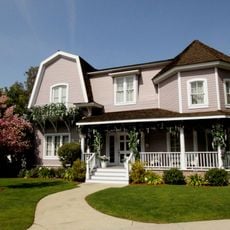
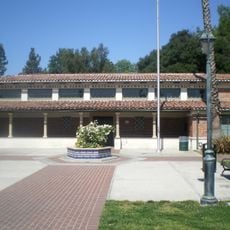
Campo de Cahuenga is a historic site in Studio City featuring Spanish Colonial Revival architecture and ground markings that show where the original adobe foundation lies beneath Lankershim Boulevard. The center holds artifacts spanning five periods of California's past, from Spanish Mission times through the Civil War era.
The original adobe on this site was demolished in 1900. On January 13, 1847, Lieutenant Colonel John C. Frémont and Captain Andrés Pico signed the Capitulation of Cahuenga there, ending the Conquest of California; the Treaty of Guadalupe Hidalgo of February 2, 1848, secured California for the United States. The city bought the property in 1923 and dedicated a replica ranch house on November 2, 1950.
The name Cahuenga comes from the Tongva language and means "place of the fox"; it was also the name of a Tongva settlement whose location is now unknown. The museum collection covers the Spanish mission period (1769–1833) to the American Civil War (1861–1865), including the Capitulation of Cahuenga document and artifacts owned by Frémont and Pico.
The site sits along a busy street with good transit access and straightforward ground layout. You can walk around the open-air display on your own or wait for a scheduled tour with knowledgeable guides.
The Campo de Cahuenga site is often confused with the nearby Rancho Cahuenga, an inholding within the Rancho Providencia land grant that is now part of Burbank. The two are separate properties with different histories, despite the shared name.
The community of curious travelers
AroundUs brings together thousands of curated places, local tips, and hidden gems, enriched daily by 92,629 contributors worldwide.