Cabrillo Bridge, Historic concrete bridge in Balboa Park, San Diego, United States
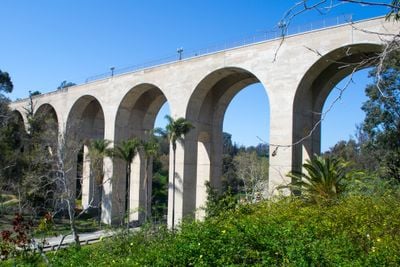
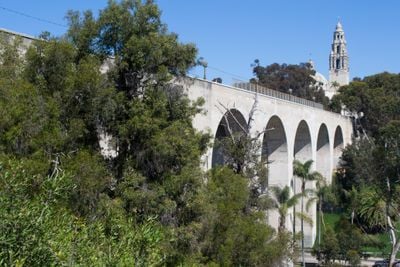
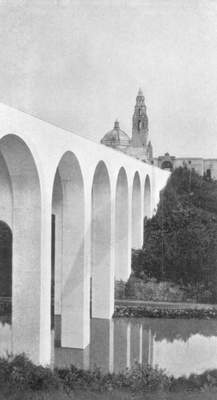
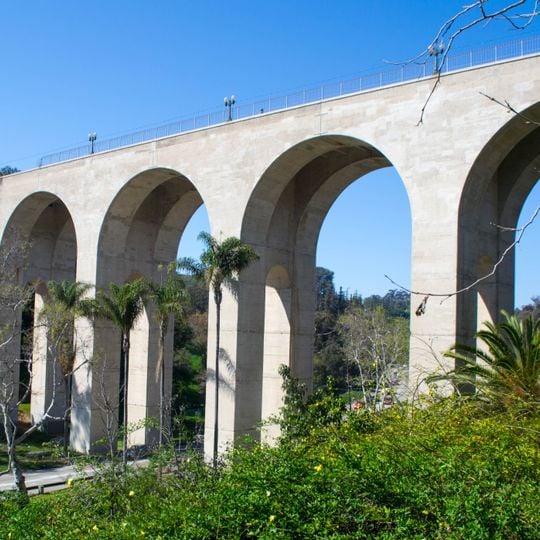
Cabrillo Bridge is a reinforced concrete structure spanning a canyon in Balboa Park, built with seven arches and sturdy support pillars. The crossing links two sections of the park over a deep ravine with pedestrian and vehicle pathways.
Construction began in December 1912 under supervisor Frank P. Allen Jr., who steered commissioners away from Bertram Goodhue's three-arch design toward Thomas B. Hunter's cheaper multiple-arched cantilever plan, the first of its kind in California. The bridge was dedicated on April 12, 1914, not completed: Franklin D. Roosevelt, then Assistant Secretary of the Navy, made the inaugural automobile crossing with Mayor Charles F. O'Neill. It opened for the 1915 Panama–California Exposition.
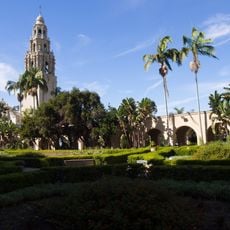
The bridge is named after Juan Rodríguez Cabrillo, the first European to chart San Diego Bay. Its deck forms El Prado, the street that leads to the museums of the former 1915 exposition grounds. Many visitors call it the Laurel Street Bridge, though Laurel Street only begins where El Prado ends at Sixth Avenue.
The bridge is open for both pedestrians and vehicles, offering views into the canyon below. The best way to experience it is a slow walk across the wide pathways from one end to the other.
The bridge's hollow concrete pillars still contain redwood formwork from 1912. Fires in 1951, 2004 and 2013 smoldered inside them; after the 2004 blaze, firefighters cut holes in the sidewalks with jackhammers to pump in foam, and the repaired patches can be spotted while walking across.
The community of curious travelers
AroundUs brings together thousands of curated places, local tips, and hidden gems, enriched daily by 92,722 contributors worldwide.