San Diego Aqueduct, Aqueduct system in California, United States.
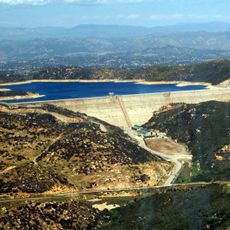
The San Diego Aqueduct is a system of four pipelines that carries Colorado River water to San Vicente Reservoir, Lake Skinner and Lower Otay Reservoir. The First Aqueduct, pipelines 1 and 2, runs 70 miles from San Jacinto in precast concrete pipe 48 to 96 inches in diameter and passes through seven tunnels. The Second Aqueduct, pipelines 3 and 4, runs 94 miles, starting with a 16-mile open canal to Lake Skinner before continuing as prestressed concrete and steel pipe.
The First Aqueduct was designed by the Bureau of Reclamation and built by the Navy Department from 1945 to 1947. Pipeline 2 was added by the Bureau of Reclamation between 1952 and 1957, roughly paralleling Pipeline 1. The Metropolitan Water District began Pipeline 3 in 1957 and completed it in May 1960; Pipeline 4 followed from 1968 to 1971.
The system reflects how the region adapted to living in dry conditions through engineering solutions. It shows the role of large-scale water projects in shaping local life and development.
The aqueducts are buried pipelines, canals and tunnels, not a walkable route; the open canal section runs the first 16 miles from the Colorado River Aqueduct to Lake Skinner. The First Aqueduct ends at San Vicente Reservoir, about 15 miles northeast of San Diego, and the Second at Lower Otay Reservoir. The Fallbrook-Ocean Branch feeds Murray Reservoir and the La Mesa-Sweetwater Branch feeds Sweetwater Reservoir.
Some sections of the system were engineered to move water uphill using pressure, overcoming California's challenging topography. This solution demonstrates the creative problem-solving required to supply water across such varied and distant terrain.
The community of curious travelers
AroundUs brings together thousands of curated places, local tips, and hidden gems, enriched daily by 94,260 contributors worldwide.