Cotzumalhuapa, Pre-Columbian archaeological site in Escuintla, Guatemala.
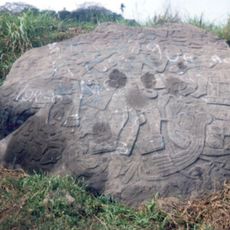
Cotzumalhuapa is a pre-Columbian Maya archaeological zone on the Pacific piedmont of Escuintla, Guatemala, covering more than 10 square kilometres. It comprises three main compounds — El Baúl, Bilbao and El Castillo — plus the minor site of Golón, linked by stone-paved causeways and bridges. Its main structures were built of earthen filling and carefully chosen stones; more than 200 structures and 187 sculptured monuments have been found, ranging from the Preclassic to the Late Classic (600–1000 CE).
Cotzumalhuapa was occupied from the Middle Preclassic and grew into a major city during the Late Classic (600–1000 CE), covering over 10 square kilometres with the El Baúl, Bilbao and El Castillo compounds. Stela 1 from El Baúl carries one of Mesoamerica's earliest inscriptions, with a Long Count date equivalent to 37 BCE. Its sculptural style spread along 200 km of the Pacific coast, reaching Cara Sucia in El Salvador.
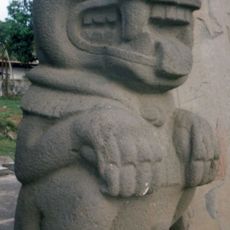
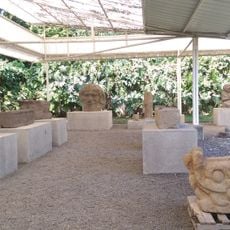
The art here displays human figures with distinct facial features and symmetrical bodies, which contrasts clearly with traditional Maya artistic styles. This approach offers insight into how the local culture viewed and represented people.
The complex spreads across different areas, so it helps to plan which sections to visit and possibly use a guide for navigation. The main artifacts are displayed in the museum, making it easy to understand what you are seeing in the ruins.
The corpus of more than 200 monumental sculptures extends beyond the three main compounds: examples of the Cotzumalhuapa style appear at Palo Verde, Aguna and Palo Gordo, and as far as Cara Sucia in El Salvador, the southeastern limit of the zone. The style also reached the Antigua Guatemala region in the highlands.
The community of curious travelers
AroundUs brings together thousands of curated places, local tips, and hidden gems, enriched daily by 93,339 contributors worldwide.