Piedras del Tunjo Archaeological Park, Archaeological site in Facatativá, Colombia
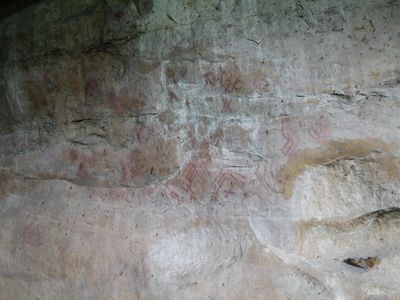
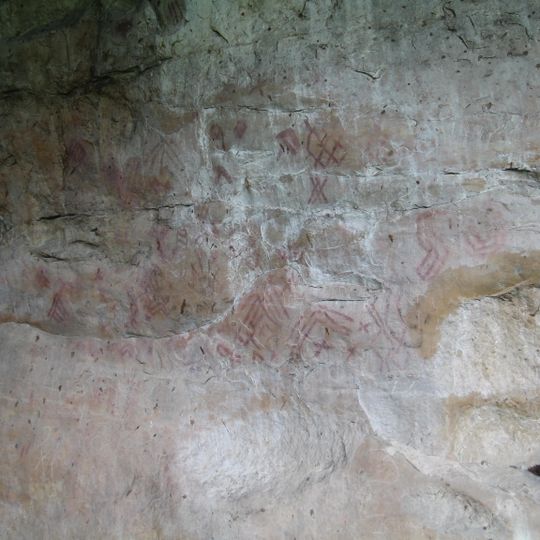
Piedras del Tunjo Archaeological Park, also called Piedras del Tunjo or Parque Arqueológico de Facatativá, is a set of pictographs on horizontal banks of weathered sedimentary rock, mainly sandstone of the Guadalupe Formation, scattered irregularly among reddish clay sediments. The paintings are red and opaque, with angular geometric shapes such as chevrons, nested lines, lozenges and crossed forms; some on stone 16 turned white after the 2004 restoration.
The paintings' age and authorship are undetermined: they may reach 12,000 years and could be Muisca or Herrera period, and it is unknown whether they belong to one or several epochs. The rocks were a spiritual place for the Muisca living here at the Spanish arrival. In 1946 education minister Germán Arciniegas began the expropriation that created the park, completed only in 1969; administration passed to the Instituto Etnológico Nacional, later Colcultura, and since 1972 the CAR holds it on loan.
The name Tunjo refers to the small gold figurines that the Muisca offered in lakes and caves; the rocks were a spiritual place for the Muisca living in the area when the Spanish arrived. The meaning of the paintings has been lost, and readings based on universal symbols remain speculation. Red is the usual colour, but after the 2004 restoration some figures on stone 16 are white.
The park lies in the urban area of Facatativá, about 40 km west of Bogotá. A marked trail leads past the most important pictographs, though many panels are badly deteriorated. Climbing on the rocks is discouraged because it damages the paintings, and wetting them to make them visible leaves salt deposits.
The park holds one of the largest concentrations of pictographs inside an urban area. Most figures are red, but after the 2004 restoration some on rock 16 turned out white. Visitors often wet the paintings to see them better, a habit that leaves salt deposits and flakes the stone.
The community of curious travelers
AroundUs brings together thousands of curated places, local tips, and hidden gems, enriched daily by 92,781 contributors worldwide.