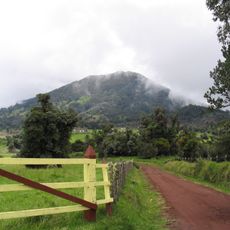
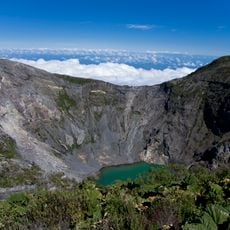
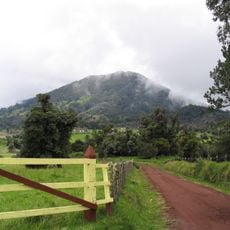
Irazú Volcano, stratovolcano in Cordillera Central, Costa Rica
Irazú Volcano is an active stratovolcano in the Cordillera Central of Costa Rica, reaching 3,432 meters. Its summit holds five craters, including the almost circular Main Crater, about 1,050 meters wide and 300 meters deep, and the Diego de la Haya crater, 600 meters wide and 100 meters deep. The Main Crater contains an opaque turquoise-green lake, and fumaroles remain active on its inner walls.
The first recorded eruption took place in 1723, described by governor Diego de la Haya Fernández, whose name was later given to one of the craters. The most famous eruption began in March 1963, just as US President John F. Kennedy arrived on a state visit, and ash fell on San José and the central highlands for two years. A one-day phreatic eruption on 8 December 1994 sent lahars down a flank vent.
The name may derive from "ara" (point) and "tzu" (thunder), or from Iztarú, an indigenous village on the volcano's flanks in 1569. Costa Ricans call it "El Coloso" for the catastrophes it has caused. A Basque-French surname Irazú, meaning "place of ferns", also fits the high-altitude ferns on its slopes.
A paved road climbs from Cartago right up to the summit craters, and a daily bus also reaches the top. Temperatures at the summit range from about 3 to 17 °C, with records near −3 °C, and the peak is usually under cloud, so clear views of both coasts are rare. Bring warm, windproof layers.
The 1963 eruption began just as US President John F. Kennedy arrived in Costa Rica, and ash fell on San José. Volcanologists later found that the magma behind it rose from the mantle in only a few months, a route the study authors called the highway from hell.
The community of curious travelers
AroundUs brings together thousands of curated places, local tips, and hidden gems, enriched daily by 93,782 contributors worldwide.