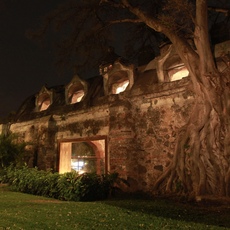
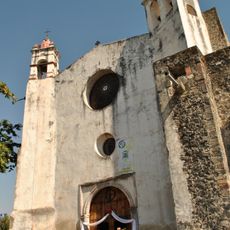
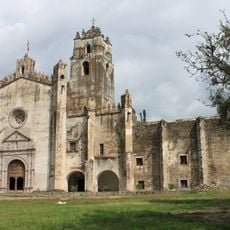
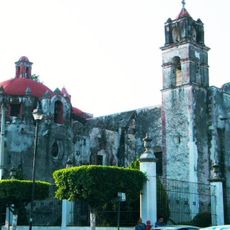
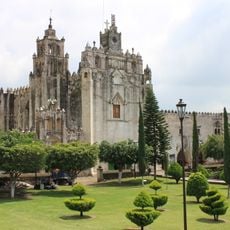
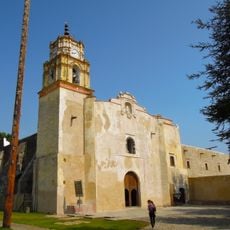
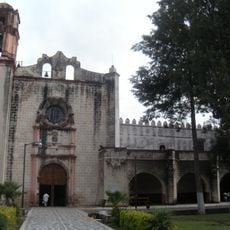
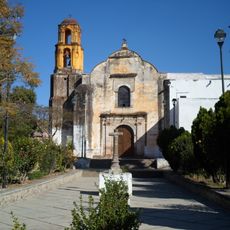
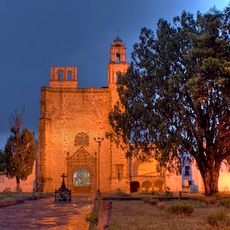
Former convent of Saint Dominic de Guzmán, Colonial convent in Hueyapan, Mexico
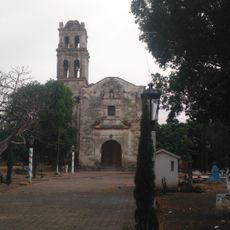
The former convent of Saint Dominic de Guzmán stands in San Andrés Hueyapan, a Nahuatl-speaking village of adobe houses and wool textiles on the slopes of the Popocatépetl in Tetela del Volcán, Morelos. Founded in 1539, the Dominican complex preserves the Nicho de Hueyapan, a sculpture carved from a single piece of wood.
The Dominican convent was founded in 1539 in San Andrés Hueyapan, a Nahuatl-speaking village of adobe houses and wool textiles on the slopes of the Popocatépetl. In 1994 it was inscribed as a UNESCO World Heritage Site together with thirteen other 16th-century monasteries of Morelos and Puebla, under the listing First Monasteries of the Sixteenth Century on the Slopes of Popocatépetl.
The village of San Andrés Hueyapan keeps Nahuatl as a living language and adobe houses and wool weaving as everyday features, and the convent stands within this setting. The "nicho de Hueyapan", a wooden sculpture carved from a single piece of wood, is kept here and draws visitors to the site.
The convent stands in San Andrés Hueyapan, a Nahuatl-speaking village of adobe houses and wool weaving in the municipality of Tetela del Volcán, Morelos, on the slopes of Popocatépetl. The church is still in use for worship, so visits should be timed around services. The village is reached by road from Tetela del Volcán; the altitude of the volcano's foothills makes warm clothing useful.
Inside the convent is the "nicho de Hueyapan", a sculpture carved from a single piece of wood, which the source names as the reason the journey to the village is worthwhile. The village around it keeps adobe houses, wool weaving and the Nahuatl language.
The community of curious travelers
AroundUs brings together thousands of curated places, local tips, and hidden gems, enriched daily by 93,762 contributors worldwide.