Palacio de Hierro de Orizaba, Art Nouveau building in Orizaba, Mexico.
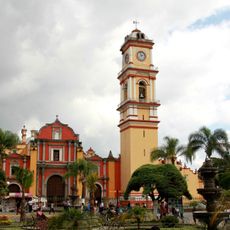
The Palacio de Hierro de Orizaba is a two-level municipal palace on Madero Street, built of a steel and wood frame with forged iron details. Its pale green facade carries red horizontal bands and dark structural framing; a central tower rises above the roofline, topped by a steep four-sided roof with a small arched opening and finial, an open gallery of arches and a round clock face with a white dial. A ground-level arcade of arches and an upper balcony with a red-and-green railing run along the main block, and a tree stands before the entrance.
In 1891 the Orizaba municipality, led by Julio M. Vélez, bought the dismountable metal structure from the Belgian Société Anonyme des Forges d'Aiseau, designed by Joseph Danly; the sources also name Gustave Eiffel as a possible designer. The parts arrived from Antwerp in three ships and were assembled by Mexican engineers Arturo B. Boca and Ricardo Segura. The palace opened on 16 September 1894 and served as the town hall for 97 years, until 1991.
The palace was conceived as a symbol of Orizaba's modernity during the Porfirian era, when the city was Mexico's fifth most important and Veracruz's wealthiest. Its name comes from its all-metal structure, and the Sala Eiffel inside is named after Gustave Eiffel, though the design is attributed to Belgian architect Joseph Danly. Today the building houses the city's tourism offices and six museums, including the Beer Museum and the Cradle of Football Museum.
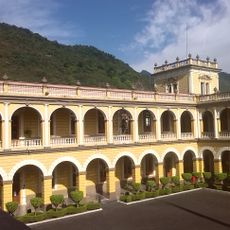
The building stands on Madero Street between Poniente 2 and 4, facing the Plaza de Armas. Its ground-level arcade of arches shelters the entrance, and the tourism office inside is the place to ask about visiting hours for the six museums and the Rodolfo Neri Vela planetarium. The clock tower rises above the main block, so the facade is easy to find from the square.
The entire structure is made from about 3369 individual metal pieces that were shipped from Antwerp to Veracruz and then assembled in Orizaba. This assembly approach allowed all components to be transported and reassembled if needed.
The community of curious travelers
AroundUs brings together thousands of curated places, local tips, and hidden gems, enriched daily by 94,528 contributors worldwide.