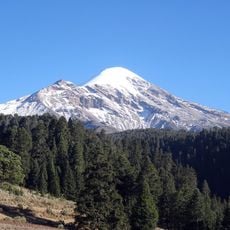
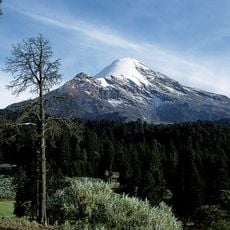
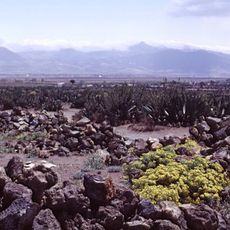
High Altitude Water Cherenkov Experiment, Gamma ray observatory at Sierra Negra volcano, Mexico.
The High Altitude Water Cherenkov Experiment is an astronomical observatory located on the slopes of the Sierra Negra volcano in the state of Puebla, Mexico. It consists of around 300 water-filled tanks fitted with light detectors that register signals produced when cosmic particles enter the Earth's atmosphere.
The observatory opened in 2015, building on earlier detection methods that had focused on lower-energy cosmic radiation. The new setup extended the range of detectable events to the most energetic phenomena coming from distant parts of the universe.
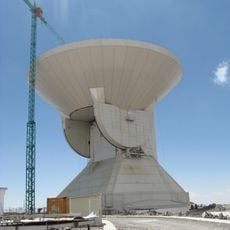
HAWC is run by a collaboration of 15 US and 12 Mexican institutions, including the University of Maryland, UNAM, INAOE and Los Alamos National Laboratory. Its name comes from the water Cherenkov method it uses, and the site lies one kilometre north of the Gran Telescopio Milimétrico Alfonso Serrano.
HAWC is a working research facility, not a site with visitor amenities, so access is arranged in advance rather than through a public entrance. It stands 4,100 m up the northern flank of Sierra Negra, about 1 km north of the Gran Telescopio Milimétrico Alfonso Serrano, and the thin air at that height calls for a slow approach.
HAWC's first scientific result came from just 10% of the array: it measured the Moon's shadow, a deficit of cosmic rays in the Moon's direction, and the finding was reported by the BBC. The full 300-tank observatory was officially inaugurated in March 2015.
The community of curious travelers
AroundUs brings together thousands of curated places, local tips, and hidden gems, enriched daily by 94,388 contributors worldwide.