Bayou Grande Cheniere Mounds, Archaeological site in Plaquemines Parish, Louisiana, United States.
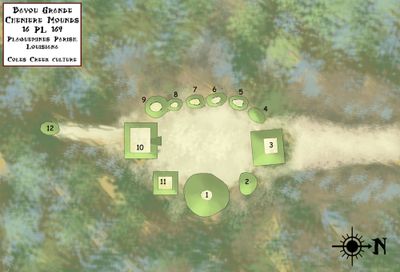
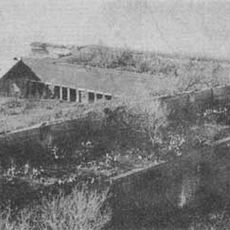
Bayou Grande Cheniere Mounds (16 PL 159) is an archaeological site on a natural levee of Bayou Grande Chenière in Plaquemines Parish, Louisiana. It holds twelve mounds: eleven ring an elliptical plaza measuring 30 by 23 metres, and a twelfth lies 75 metres south, joined to the group by a built landform. Mound 1, a conical mound 18 metres high, stands on the plaza's eastern edge; platform Mounds 10 and 3 close the south and north sides, and interconnected small Mounds 4 to 9 line the west.
The site was occupied from 875 to 1200 CE during the Coastal Coles Creek period, representing a substantial timespan of habitation. Scientific investigations began in 1926 when the Smithsonian Institution conducted the initial excavations.
The site's name comes from Bayou Grande Chenière, the waterway whose natural levee it occupies; "chenière" is the Louisiana French word for a ridge lined with oak trees. The plaza's elliptical plan, about 30 by 23 metres, is framed by platform mounds on its north and south edges and a chain of small mounds on the west.
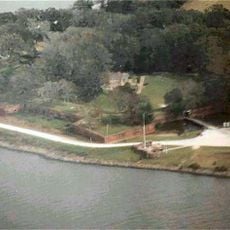
The site lies on a natural levee of Bayou Grande Chenière in Plaquemines Parish, southeast Louisiana, and is reached by road; the twelve mounds and the plaza are on foot. The elliptical plaza measures about 30 by 23 metres, with Mound 1, roughly 18 metres high, on its eastern edge. The ground is unconsolidated earth, so expect uneven, soft or muddy footing after rain.
The causeway linking the site to Bayou Grande Chenière was not found by excavators but by a remote-sensing survey in the late 2000s, run by NASA's Stennis Space Center with the US Army Corps of Engineers New Orleans District and Tulane University across the southeastern Louisiana marshes.
The community of curious travelers
AroundUs brings together thousands of curated places, local tips, and hidden gems, enriched daily by 93,905 contributors worldwide.